






- July 27, 2026
Migration Advisory Panel Proposal Could Remove Sponsorship Route for More Than 20 Occupations
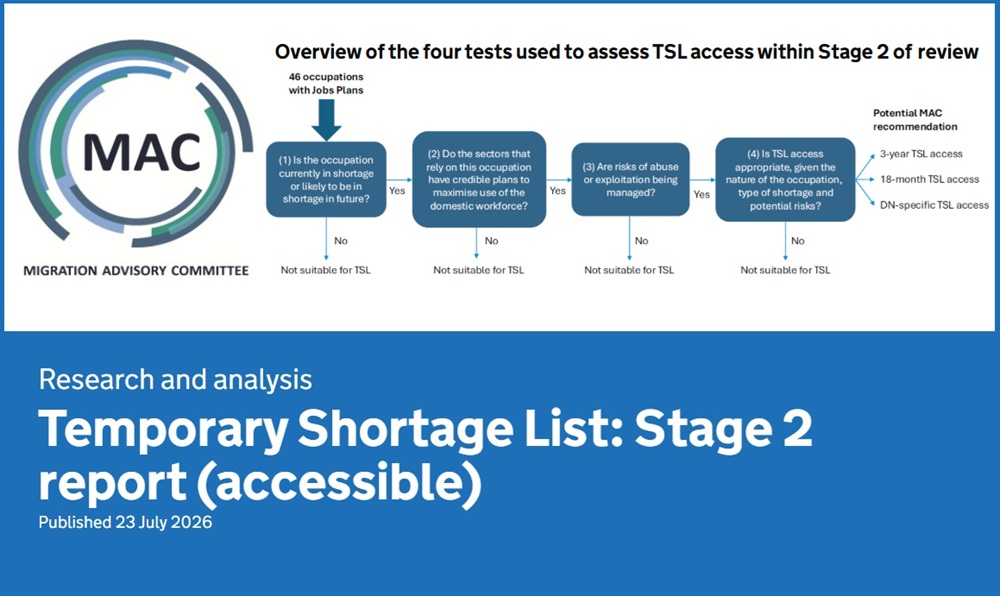
LONDON July 27: The UK immigration system could undergo another major change following the publication of the Migration Advisory Committee’s (MAC) Stage 2 review of the new Temporary Shortage List (TSL). While these proposals are not yet law, they could significantly reduce the number of occupations eligible for sponsorship below degree level.
Why is the Temporary Shortage List Being Introduced?
The TSL forms part of the Government’s 2025 Immigration White Paper, Restoring Control over the Immigration System. The reforms aim to reduce reliance on overseas recruitment while encouraging employers to invest more in training the UK workforce.
As part of these changes, the Skilled Worker visa has been restricted to graduate-level occupations (RQF Level 6 and above). The TSL replaces the previous Immigration Salary List and provides temporary access to sponsorship for selected RQF Level 3–5 occupations that are considered vital to the UK’s Industrial Strategy or critical infrastructure. Unlike previous shortage occupation lists, sectors must now produce credible workforce “Jobs Plans” demonstrating how they will reduce long-term reliance on overseas workers.
What Has the MAC Recommended?
Following its review of 82 occupations, the MAC concluded that no occupation justified the maximum three-year placement on the Temporary Shortage List. Instead, it recommended that 28 occupations receive temporary access for just 18 months. After that period, the Government will review whether those occupations should remain eligible for sponsorship.
The recommended occupations are concentrated in sectors considered essential to economic growth and infrastructure delivery, including: Engineering technicians, Electricians, Welders, Bricklayers, Plumbers, Carpenters, Roofers, Plasterers, Telecommunications installers, Database administrators, Data analysts, CAD technicians. Many of these occupations were supported because they are critical to housebuilding, clean energy and major infrastructure projects, even where workforce plans were not considered particularly strong.
Click To Read Temporary Shortage List Review
Occupations Recommended for Removal
The MAC recommended that 18 occupations should not receive TSL access, meaning they would lose sponsorship eligibility if the Government accepts the recommendations.
The occupations fell into three categories:
1. No Evidence of Labour Shortages
Seven occupations were found not to be experiencing genuine labour shortages. These included:
Laboratory technicians, Quality assurance technicians, Marketing associate professionals, Business development managers, Aircraft maintenance trades, Skilled trades supervisors
The MAC found little evidence of recruitment pressures or sustained shortages in these occupations.
2. Weak Workforce Plans
A further seven occupations were rejected because employers failed to demonstrate credible plans to recruit and train more domestic workers. These included:
Logistics managers, Financial and accounting technicians, Business sales executives, Estimators, Standards inspectors, Refrigeration installers, Security system installers
The committee criticised many of the submitted Jobs Plans for being too generic and lacking measurable actions.
3. Not Appropriate for the TSL
Two occupations met some of the criteria but were still considered unsuitable:
Design occupations (n.e.c.)
Vehicle technicians, mechanics and electricians
The MAC concluded that design occupations were too broad to justify inclusion, while most vehicle technicians work outside the Industrial Strategy sectors the TSL is intended to support. It also considered domestic retraining a better long-term solution than immigration for vehicle technicians.
Special Treatment for Dancers and Musicians
The MAC also recommended separate treatment for certain performers.
Rather than including Dancers and Choreographers and Musicians on the Temporary Shortage List, it proposes that specific highly skilled roles should instead qualify under the Skilled Worker route.
These include: Classical ballet dancers, Contemporary dancers and Orchestral musicians
Only performers who meet the standards of internationally recognised UK companies and orchestras would qualify. The committee considers these roles exceptional because they require internationally recognised, degree-level expertise rather than filling temporary labour shortages.
What Happens Next?
These recommendations are advisory only. The Home Office will decide whether to accept them and has not yet confirmed when any changes would take effect or how they would affect:
Existing sponsored workers, Pending visa applications, Future sponsorship applications
If implemented, the proposals would significantly reduce sponsorship opportunities for many mid-skilled occupations while maintaining temporary access for a limited number of construction, engineering and infrastructure-related roles that are considered essential to the UK’s economic priorities.