






- November 2, 2026
£25,000 required for migrant care workers to apply for ILR in 5 years or wait for 10 years
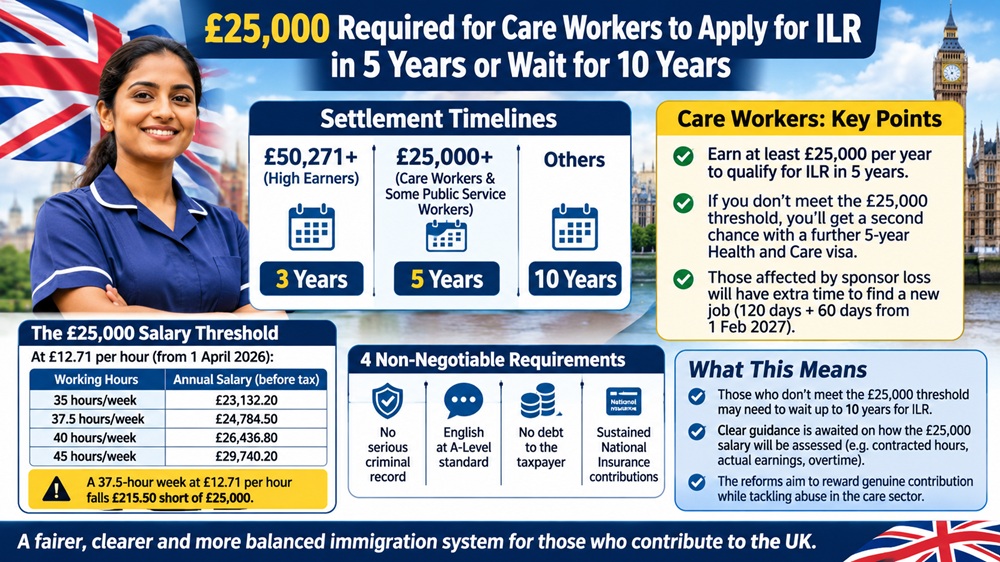
LONDON Nov 2: The right to live in the UK forever will no longer be granted to migrants almost automatically after 5 years. Instead, it will be earned, under the new earned settlement model set out before Parliament yesterday. Recognising that settled status is a significant privilege which allows free and unrestricted access to the labour market, NHS and welfare system, the reforms will mean that how long someone waits will now depend on their contribution and character. The highest earners will be able to settle within 3 years. Those earning more than £50,271 and some public service workers – like doctors, nurses and teachers – will be able to settle after 5 years. Others will settle at a new default of 10 years. Those who have breached immigration rules will only be able to settle after at least 20 years.
Care workers who entered, or switched into, the route before May 2025 will retain the existing five-year qualifying period for settlement where they meet the applicable salary (£25,000 a year), sponsorship and employment requirements. They will also need to meet the strengthened minimum requirements that will apply generally under Earned Settlement, including on criminality and English language, unless an exemption applies. Those who do not meet the requirements will not qualify after five years.
There is, however, a case for giving those who do not qualify after five years a further opportunity to meet the requirements. The care sector saw exceptional levels of sponsor failure, exploitation and poor practice during the period in which this cohort was recruited. Some workers who came to the UK were left without the work they had been promised, making it harder for them to meet the requirements of the route.
The government will therefore give these individuals a second opportunity to meet those requirements. Those who do not qualify for settlement after five years will be able to apply for a further five-year Health and Care visa, restricted to genuine work in the sector. This will give them additional time to meet the requirements before applying for settlement again. They will continue to have no recourse to public funds while on that further visa.
The government recognise that some care workers have found themselves without a sponsor through no fault of their own, including where an employer has had its license revoked. In these circumstances, the Government will continue to work with the care worker to help them find a new employer.
Given the exceptional levels of sponsor abuse and failure experienced on the care route, care workers who are employed by sponsors whose license has been revoked will also be given longer than other sponsored workers to secure new employment and regularise their immigration status. From 1 February 2027 care workers who have lost their employment due to the sponsor licence being removed will have up to 120 days to get a secure job offer, and a further 60 days to resolve their visa and employment status. If they are not able to secure a job offer within 120 days, or resolve their employment status within 180 days, we will curtail their visa, and the individual will need to leave the UK.
These arrangements will apply only to care workers who entered, or switched into, the route before publication of the Immigration White Paper in May 2025. Those entering after that point will qualify through the standard 10-year Earned Settlement pathway.
How the £25,000 Salary Threshold May Affect Care Workers Applying for ILR
At this stage, it is not yet clear how the proposed £25,000 salary threshold will be assessed under the Government’s announcement. Further clarification through detailed caseworker guidance will be needed to establish exactly how the annual salary requirement will be applied to Indefinite Leave to Remain (ILR) applications. As of 1 April 2026, the UK National Minimum Wage for care workers aged 21 and over is £12.71 per hour.
Based on this hourly rate, the annual gross salary (before tax) would be as follows:
| Working hours | Annual gross salary |
|---|---|
| 35 hours per week | £23,132.20 |
| 37.5 hours per week | £24,784.50 |
| 40 hours per week | £26,436.80 |
| 45 hours per week | £29,740.20 |
What does this mean for care workers?
For a care worker working a standard 37.5-hour week at £12.71 per hour, the annual gross salary would be approximately £24,784.50. This falls £215.50 short of the proposed £25,000 threshold. Similarly, a care worker employed on a 37-hour-per-week contract at this hourly rate would also fall short of the £25,000 annual salary requirement.
If the Government applies the £25,000 threshold strictly to annual contracted earnings, care workers who do not meet this requirement could potentially be affected by the proposed changes. Depending on the final transitional arrangements and eligibility rules, this could mean having to complete an additional five years before qualifying for ILR.
The key issue is how the Government intends to calculate the £25,000 annual salary requirement. Will it be based on contracted working hours, actual annual earnings, overtime, or other forms of additional pay? Until detailed caseworker guidance and the final rules are published, it would be premature to draw a definitive conclusion about how individual care workers will be affected. Clear guidance from the Government is essential to remove the uncertainty and ambiguity surrounding this issue.
Anyone seeking settlement, regardless of when they arrived in the country, will first need to meet 4 non-negotiable conditions:
a spotless criminal record (up from the current threshold of a 12-month suspended sentence)
English spoken to a high standard (equivalent to A-Level English as a foreign language)
no debt owed to the taxpayer
a record of sustained National Insurance contributions
The reforms are largely in line with those set out in the November 2025 consultation However, the government has set out a new, fair deal for care workers.
In recognition of the contribution care workers made to Britain when the sector was reeling from the COVID-19 pandemic, those who met their visa conditions and earned at least £25,000 a year will be able to settle after 5 years. But the care worker route was also abused, with rogue and exploitative companies sponsoring workers for jobs that did not exist. Under this government, 1,800 exploitative employers have been stripped of their right to sponsor foreign workers.
Those who do not qualify for 5-year settlement – around a quarter of the total – will be offered a second chance to contribute through a new 5-year visa. They will be able to apply for settlement only once these have been completed. A similar approach will apply to public service workers in healthcare and education who arrived during the same period.
Settlement rules will otherwise continue to apply at the point of application, as they always have in Britain and internationally. As a result, an estimated over 500,000 people will wait longer than 5 years to settle, taking billions off the welfare bill. No one will be forced to leave, and everyone will have a fair chance to apply for new visas that would allow them to settle after 10 years.