






- November 17, 2026
UK Govt Asked To Rethink Its “Talent” Visas: What It Means for Future Migrants: Read Recommendations

LONDON Nov 17: For ambitious professionals, entrepreneurs and innovators considering a move to the UK, a major government review has delivered a clear message: the UK still wants highly skilled global talent, but it is becoming more cautious about immigration routes that fail to show clear economic benefits. A new review by the UK’s Migration Advisory Committee (MAC), an independent body that advises the government on immigration policy, examined two specialist visa categories: the Global Talent visa and the Innovator Founder visa. Its findings could shape the future of how talented migrants enter and settle in Britain.
Good News for Highly Skilled Professionals
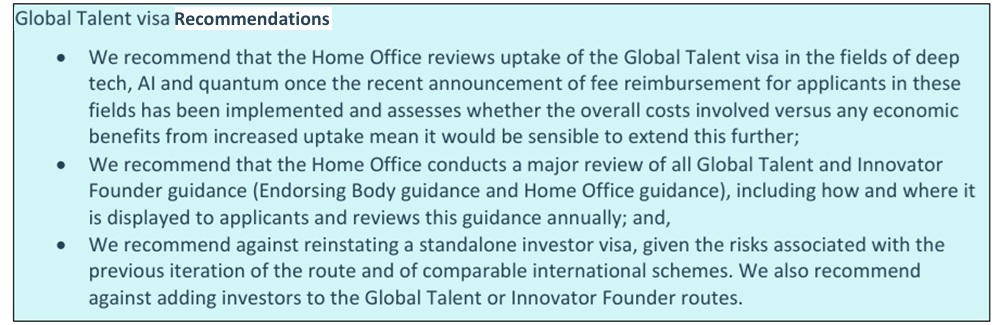
The strongest endorsement in the report was reserved for the Global Talent visa. Designed for leaders and emerging leaders in fields such as science, technology, engineering, medicine, academia, arts and culture, the route allows individuals to move to the UK without requiring sponsorship from an employer. According to the review, most Global Talent visa holders go on to secure employment, earn competitive incomes and contribute positively to the UK economy. Researchers, scientists, engineers and technology specialists were among the largest groups of successful applicants. For prospective migrants, this is a significant signal. Rather than recommending major restrictions, the committee concluded that the route is broadly successful and should continue. The report suggests that Britain remains committed to attracting world-class expertise, particularly in sectors that support innovation, research and economic growth.

A Greater Focus on Financial Sustainability
However, the review also highlighted an issue that may surprise some applicants. While many Global Talent migrants perform well economically, a minority were found to have very low earnings, with some reporting incomes below levels associated with full-time minimum wage employment. As a result, the committee has recommended introducing a minimum earnings requirement when migrants apply for permanent settlement. Importantly, this would not affect entry to the visa route itself. Instead, applicants seeking indefinite leave to remain in the UK may need to demonstrate that they are earning enough to support themselves through sustained employment or professional activity. For future migrants, the message is clear: exceptional talent will continue to be valued, but long-term residence may increasingly depend on demonstrating economic self-sufficiency.
Tough Verdict for Entrepreneurs
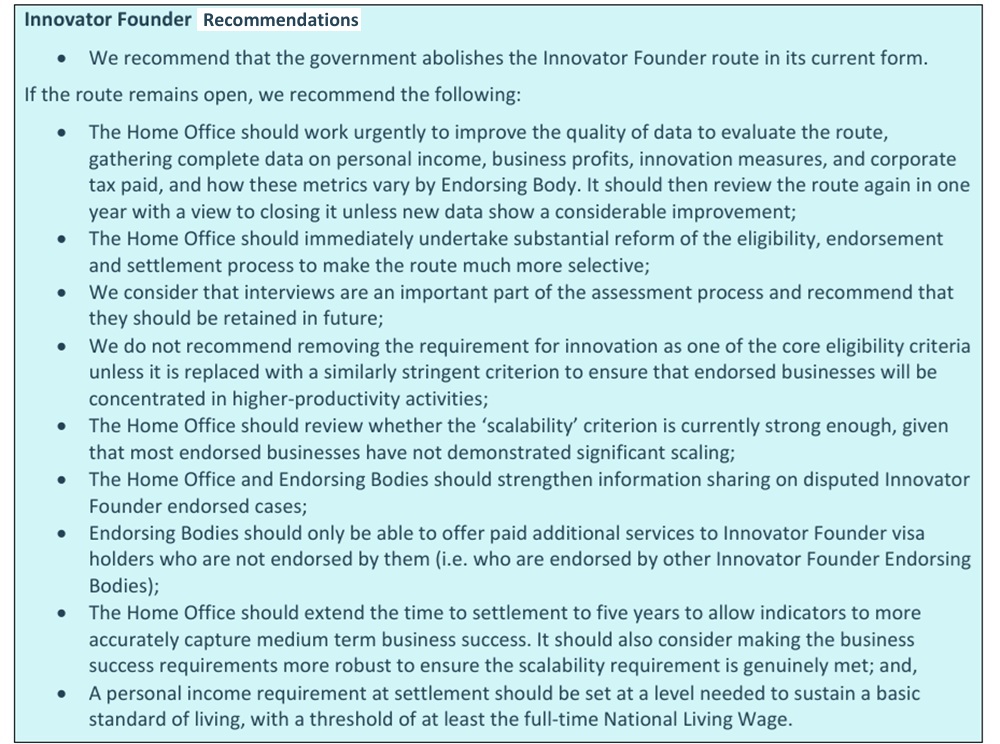
The biggest surprise in the report concerns the Innovator Founder visa. Introduced to attract international entrepreneurs with innovative business ideas, the visa was intended to bring high-growth companies, investment and job creation to the UK. The committee’s analysis, however, paints a less encouraging picture. Many businesses established through the route remained very small several years after launch. Revenue levels were often modest, and most firms employed only a handful of people. While some companies achieved impressive growth, these success stories were the exception rather than the rule. The review concludes that the route has generally failed to generate the level of innovation and economic impact that policymakers originally anticipated.
Could the Innovator Founder Visa Be Scrapped?
The committee’s recommendation is unusually direct. Rather than making minor adjustments, it argues that the Innovator Founder route should either be abolished altogether or fundamentally redesigned. For would-be entrepreneurs, this creates uncertainty. While the government has not yet made a final decision, the review suggests that future business immigration routes could become much more selective, placing greater emphasis on proven entrepreneurial track records, commercial potential and measurable economic value. Anyone considering this pathway should closely monitor future policy announcements.
Investor Visas Unlikely to Return
The review also addressed calls to revive the UK’s former Investor Visa programme, which allowed wealthy individuals to gain residence rights through significant financial investment. The committee does not support bringing back a dedicated investor route. Its reasoning is straightforward: wealth alone does not necessarily deliver the economic, scientific or technological contribution that the UK now seeks from migrants. For high-net-worth individuals hoping that a simple investment-based pathway might return, the report suggests that such a move remains unlikely.
What This Means for Prospective Migrants
The review points towards a broader shift in UK immigration policy. Britain remains eager to attract exceptional scientists, researchers, engineers, technology specialists and creative professionals. Routes that can demonstrate clear economic and societal value are likely to remain protected and potentially strengthened. At the same time, the government appears increasingly unwilling to maintain immigration programmes that cannot demonstrate strong outcomes in terms of business growth, job creation or public finances. For aspiring migrants, the lesson is simple: the UK’s immigration system is moving away from promises and potential, and towards evidence of real-world achievement and economic contribution. For highly skilled professionals, that trend may create new opportunities. For entrepreneurs, however, the path to Britain could soon become much narrower.