






- November 29, 2026
Will Kerala be punished for controlling population growth? A new seat map suggests so
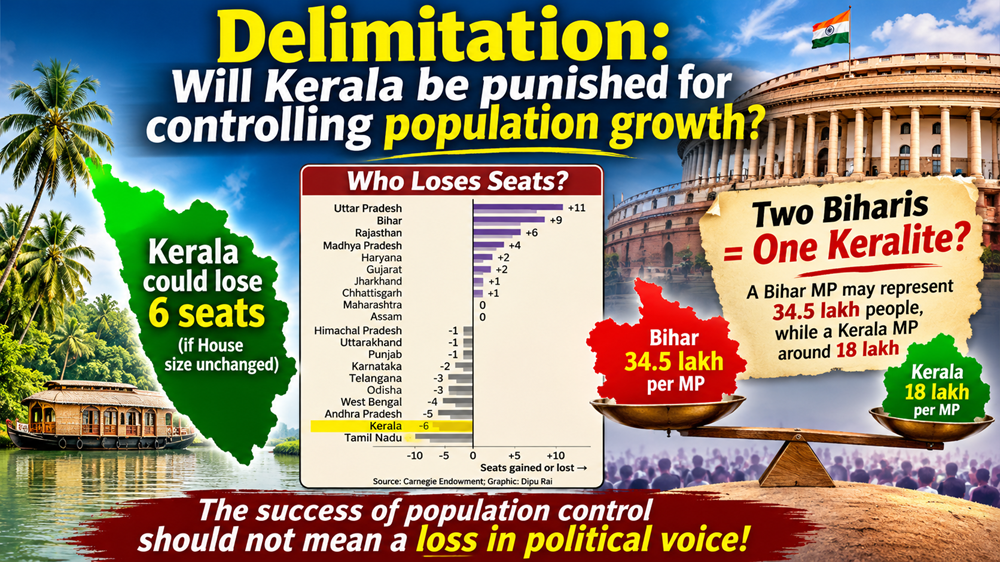
KOCHI Nov 29: Kerala’s success in population control, education and healthcare could come at a political cost. If Parliament’s seats are redistributed without increasing the size of the House, Kerala could lose six Lok Sabha seats, while Uttar Pradesh and Bihar stand to gain. Even under a proposed 50 per cent expansion, the South’s relative political influence could shrink.Kerala spent decades doing what India’s national development goals encouraged states to do: invest in education, healthcare, women’s empowerment and family planning, and bring population growth under control. Now, the state faces an unsettling prospect. Its demographic success could translate into diminished representation and political influence in the Lok Sabha.
A population-based delimitation, if undertaken without expanding the size of Parliament, could see Kerala lose six Lok Sabha seats, according to a graphic based on Carnegie Endowment analysis and published by India Today’s Data Intelligence Unit. Tamil Nadu could lose 10 seats, while Karnataka and Telangana could lose two and three seats respectively.
At the other end of the spectrum, Uttar Pradesh could gain 11 seats, Bihar nine and Rajasthan six.
The chart presents the projected changes in parliamentary representation if the map is redrawn according to population while the size of the Lok Sabha remains unchanged. Its 2026 projections indicate a stark contrast between the gains expected in several northern states and the losses projected for southern states.
Kerala’s projected loss of six seats is not an isolated outcome. It forms part of a broader pattern in which states that experienced relatively slower population growth stand to lose representation, while states with higher population growth gain political weight.
Two Biharis could count as one Keralite
The concern becomes even more pronounced under the proposed formula reportedly being considered by the Centre, which would increase Lok Sabha seats in every state by 50 per cent.
Under this formula, Kerala’s representation would increase from 20 to 30 MPs, while Bihar’s would rise from 40 to 60. Uttar Pradesh would go from 80 to 120 seats.
But the increase in seats would not erase the disparity in the number of people represented by each MP.
According to India Today’s Data Intelligence Unit, based on official population projections, a Bihar MP could represent approximately 34.5 lakh people by 2029, compared with around 18 lakh for a Kerala MP.
That means nearly 1.9 people from Bihar would be represented by one MP for every single person represented by a Kerala MP, in terms of population per seat.
The reported 50 per cent formula may prevent the immediate reduction of seats in Kerala and other southern states. But it does not address the underlying imbalance created by uneven population growth across the country.
Kerala could gain 10 seats in absolute terms and still find itself losing relative influence in national politics.
The demographic success of the South could become a political disadvantage
The delimitation debate is rooted in a policy decision taken decades ago.
Parliament froze the redistribution of Lok Sabha seats based on the 1971 Census in 1976 and extended the freeze in 2001. One of the underlying concerns was that states which had successfully reduced population growth through family planning, education and public health measures should not be penalised by losing parliamentary representation.
The freeze kept the number of seats largely unchanged, even as populations continued to grow at different rates across states.
Southern states, including Kerala, Tamil Nadu, Karnataka and Andhra Pradesh, made significant progress in literacy, healthcare, women’s education and fertility reduction. These achievements were closely linked to long-term social development and public policy.
But a future redistribution based primarily on population could alter the political balance in favour of states that experienced greater population growth.
The question is no longer simply how many seats each state should receive. It is whether states that fulfilled the country’s demographic and development objectives should bear a disproportionate political cost.
The chart exposes the potential redistribution of political power
The Carnegie-based graphic makes the potential consequences visible.
Under the projected redistribution without enlarging the House:
- Uttar Pradesh: gains 11 seats
- Bihar: gains 9 seats
- Rajasthan: gains 6 seats
- Madhya Pradesh: gains 4 seats
- Kerala: loses 6 seats
- Tamil Nadu: loses 10 seats
- Telangana: loses 3 seats
- Karnataka: loses 2 seats
The projected losses are not confined to Kerala. They indicate a wider shift in parliamentary representation away from several southern states.
Although population-based representation is a democratic principle, the consequences of such a redistribution could deepen regional disparities in political bargaining power.
The southern states fear that their ability to influence national policy, negotiate fiscal allocations and secure their interests could weaken over time.
A 50 per cent increase may soften the blow, but not solve the problem
Reports suggest the Centre may instead pursue a formula that increases the number of seats in every state by 50 per cent.
Under that approach, Kerala would go from 20 to 30 MPs, Tamil Nadu from 39 to approximately 59, Bihar from 40 to 60 and Uttar Pradesh from 80 to 120.
This would avoid outright seat losses for states and would be politically less contentious than a redistribution within a fixed-size House.
However, increasing seats proportionately does not necessarily preserve the relative influence of states. States with larger populations will continue to command a greater share of the expanded House.
An analysis by economist Amitabh Kundu found that even under a redistribution based on the 2011 Census, the five southern states would increase their combined representation from 129 to 173 seats, but their share of the seats allocated to states would fall from 24.6 per cent to 21.1 per cent.
The distinction is crucial: more MPs does not necessarily mean more political power relative to the rest of the country.
The federal question cannot be ignored
Kerala’s concern is not about denying representation to people in other states. Nor is it an argument against democracy or population-based representation in principle.
It is about whether the federal balance can be maintained when population growth becomes the primary determinant of political power.
For decades, states were encouraged to pursue family planning, improve maternal and child health, expand education and reduce fertility. States such as Kerala invested heavily in these objectives and achieved considerable success.
If those achievements now translate into a diminished share of parliamentary representation, the policy incentives and fairness of the system must be examined.
A federal system must take account of population, but it must also consider the long-term consequences of policies that governments encouraged states to pursue.
A middle path is possible
One alternative proposed in the delimitation debate is to retain the existing 524 seats allocated to states and distribute only the additional seats according to population.
This approach could allow states to gain representation without stripping existing seats from states that have achieved population stabilisation.
Such a model deserves serious consideration. It could reconcile the need to accommodate demographic changes with the need to preserve a reasonable balance between states.
The debate over delimitation should not be reduced to a binary choice between population-based representation and preserving the existing seat allocation. Other models are possible, and the federal consequences of each deserve public scrutiny.
Women’s reservation and delimitation are important, but distinct issues
The proposed delimitation exercise is also being linked to the implementation of 33 per cent reservation for women in Parliament and state legislatures.
In Kerala, a 50 per cent expansion could potentially increase the number of Lok Sabha seats from 20 to 30 and Assembly seats from 140 to 210, creating additional opportunities for women representatives.
Women’s representation is a vital democratic objective. But it should not obscure the separate issue of how parliamentary seats are distributed between states.
Both objectives can and should be pursued through a transparent process that protects democratic representation and federal fairness.
Will India penalise the states that succeeded?
The delimitation debate presents India with a difficult constitutional and political choice.
A population-based redistribution may reflect demographic realities more closely. But if it disproportionately shifts parliamentary influence towards states with higher population growth, it could weaken the voice of states that invested in population stabilisation and social development.
Kerala’s projected loss of six seats in a fixed-size House, alongside the gains projected for Uttar Pradesh and Bihar, illustrates the stakes.
The reported 50 per cent formula may offer a temporary cushion. But the fundamental issue remains unresolved: how can India ensure fair representation without penalising states for achievements in population control, education, healthcare and social development?