






- October 15, 2026
OCI Cardholder Issued Leave India Notice By India Govt After Joining Mumbai Protest
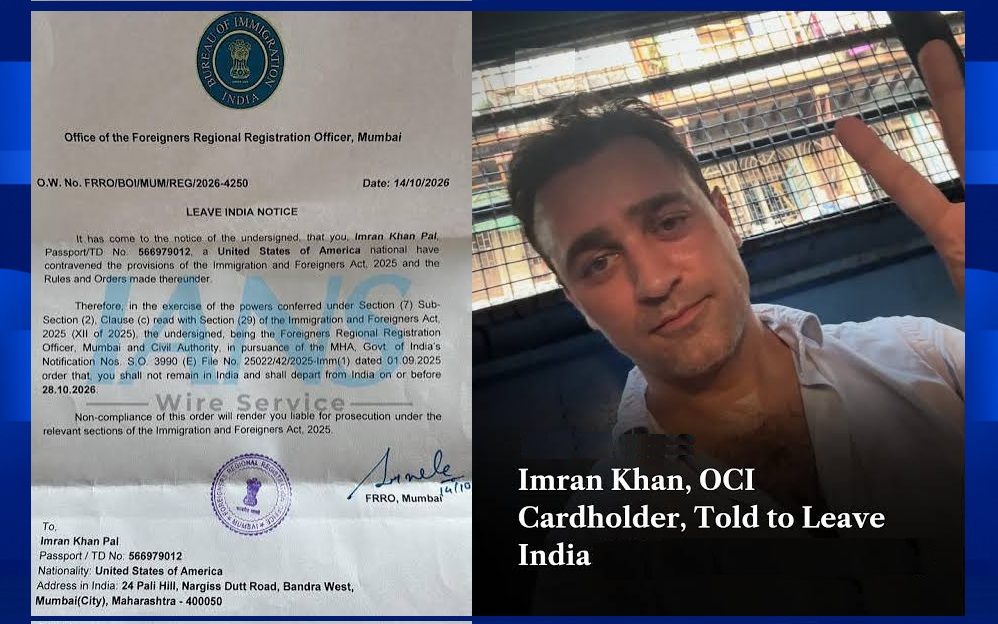
MUMBAI Oct 15: Actor Imran Khan, a US citizen and Overseas Citizen of India (OCI) cardholder, has been directed to leave India by October 28 after authorities alleged that his participation in a political protest violated immigration law. The case raises questions about the restrictions governing OCI cardholders and the extent to which they can participate in public demonstrations in India.
Imran Khan was issued a Leave India Notice by the Foreigners Regional Registration Office (FRRO) days after participating in a protest at Mumbai’s August Kranti Maidan on October 10. The demonstration demanded the resignation of Chief Election Commissioner Gyanesh Kumar. Khan was detained along with other protesters during the event.
Following the protest, BJP leader Kirit Somaiya lodged a complaint with the police, alleging that Khan, as a foreign national, had violated the law by participating in the demonstration. The complaint was subsequently forwarded to the FRRO, which issued the notice directing Khan to leave India. According to the police, the notice states that Khan is a US citizen who violated immigration law by joining the protest.
The action highlights an important distinction for OCI cardholders: although they enjoy several rights and privileges associated with long-term residence in India, they remain foreign nationals and are subject to Indian immigration laws.
What does the OCI card allow — and what are its limitations?
Introduced in 2005, the OCI scheme allows eligible foreign nationals of Indian origin to enjoy specified privileges in India. However, it does not confer Indian citizenship or permit dual citizenship.
An OCI cardholder remains a citizen of the country whose passport they hold. The status generally provides a lifelong, multiple-entry visa to India and exemption from registration with the FRRO, irrespective of the duration of stay.
OCI cardholders also receive parity with Indian citizens or Non-Resident Indians (NRIs) in certain specified areas, including some property, educational and professional rights, subject to applicable conditions.
These privileges, however, do not place OCI cardholders on the same legal footing as Indian citizens. Their right to remain in India is subject to the conditions of the OCI scheme and the government’s powers under immigration law.
Are OCI cardholders prohibited from participating in political protests?
A key issue in Khan’s case is whether participation in a political protest is, by itself, a violation of immigration law for an OCI cardholder.
A government notification issued in March 2021 requires OCI cardholders to obtain special permission before undertaking specified activities, including research, missionary or Tabligh work, mountaineering, journalistic activities, certain employment or internships in foreign diplomatic establishments, and visits to protected, restricted or prohibited areas.
Notably, the notification does not expressly list participation in political protests or demonstrations among the activities requiring prior permission.
OCI cardholders are also excluded from India’s political rights. Under Section 7B of the Citizenship Act, they cannot vote or contest elections. Article 19 of the Constitution, which guarantees rights including freedom of speech and peaceful assembly, expressly confers those fundamental rights on Indian citizens.
However, the absence of a specific prohibition on attending demonstrations in the OCI notification does not, by itself, settle whether a particular foreign national’s conduct may be restricted under other applicable laws or government orders.
The central question is whether the authorities have a valid legal basis for treating Khan’s participation in the protest as grounds for directing him to leave India.
How the Immigration and Foreigners Act, 2025, applies to OCI cardholders
The Immigration and Foreigners Act, 2025, which came into force in September 2025 and replaced the Foreigners Act, 1946, gives the government extensive powers to regulate foreign nationals in India. OCI cardholders remain foreign nationals for the purposes of this legislation.
The Act does not expressly identify participation in a political rally or demonstration as prohibited conduct. Nevertheless, it provides the government with broad powers to regulate the entry, stay, activities and conduct of foreigners.
The FRRO notice issued to Khan reportedly invokes Section 7(2)(c), read with Section 29, of the 2025 Act.
Section 7 empowers the government to issue orders regulating or restricting the entry, departure or continued presence of foreign nationals in India. Section 7(2)(c), specifically cited in Khan’s notice, allows the government to direct that a foreigner “shall not remain in India or in any specified area therein”.
Section 29 provides an additional power to order the removal of a foreigner for contravening the Act, its rules or orders made under it, or on the basis of an adverse security report. It also authorises government officers to exercise reasonable powers necessary to enforce such directions.
The distinction is significant for OCI cardholders. The legislation does not specifically designate political protest as a prohibited activity, but its broad provisions allow the government to restrict a foreign national’s continued presence in the country.
Section 7 also provides for restrictions on a foreigner’s association with specified persons, activities of a specified description and conduct. However, the notice issued to Khan invokes the power to direct a foreigner not to remain in India, rather than the provision specifically addressing restrictions on activities.
These powers are not confined to the Union Home Ministry. A government notification issued in September 2025 delegated powers under Section 7(2) and Section 29 to FRROs and Foreigners Registration Officers.
Calcutta High Court precedent: Polish student’s Leave India Notice
Khan’s case also brings into focus a 2020 judgment of the Calcutta High Court involving Polish student Kamil Siedczynski, who had participated in an anti-Citizenship Amendment Act (CAA) rally in Kolkata.
At the time, the government had invoked the Foreigners Act, 1946, to issue a Leave India Notice to the student. The High Court quashed the notice, finding it deficient and holding, under the law then applicable, that mere participation in a political rally was not, by itself, sufficient to justify the action.
The ruling is relevant because it addressed the government’s ability to take immigration action against a foreign national for participating in a political demonstration.
However, the legal framework has since changed. The Immigration and Foreigners Act, 2025, has replaced the 1946 legislation, although it retains broad executive powers to regulate the presence and conduct of foreign nationals.
The extent to which the earlier judgment may assist Khan will therefore depend on the grounds stated in his notice, the provisions invoked by the authorities and how a court interprets the new legislation.
What legal remedies are available to OCI cardholders facing a Leave India Notice?
Khan can submit a representation to the FRRO or the Central government seeking withdrawal or reconsideration of the notice.
The position differs from cancellation of OCI registration under Section 7D of the Citizenship Act, which expressly provides for a reasonable opportunity of being heard in specified circumstances. Section 7 of the 2025 immigration law does not set out a comparable appeal procedure for challenging a direction of this nature.
Another option is to approach the High Court under Article 226 of the Constitution, challenging the legality of the notice and seeking interim relief to prevent its enforcement while the case is considered. It is learnt that Khan’s lawyers have already approached the High Court.
For OCI cardholders, the case could have wider implications for understanding the boundaries between the privileges of OCI status, restrictions applicable to foreign nationals and the government’s discretionary powers under immigration law.
What happens next?
The Leave India Notice requires Khan to leave India by October 28. Unless the FRRO withdraws or modifies the direction, or a court grants an interim stay or other appropriate protection, the notice remains operative and he would be required to comply with the deadline.
The case ultimately raises a broader question for OCI cardholders: to what extent can the government use its immigration powers to restrict a foreign national’s participation in public demonstrations when the applicable OCI notification does not expressly list political protests as an activity requiring prior permission?
The answer may depend on the legal grounds relied upon by the authorities and the interpretation of the Immigration and Foreigners Act, 2025, by the court hearing the challenge.