






- November 1, 2026
UK Home Secretary Set to Announce Final Immigration Reforms on Monday November 2
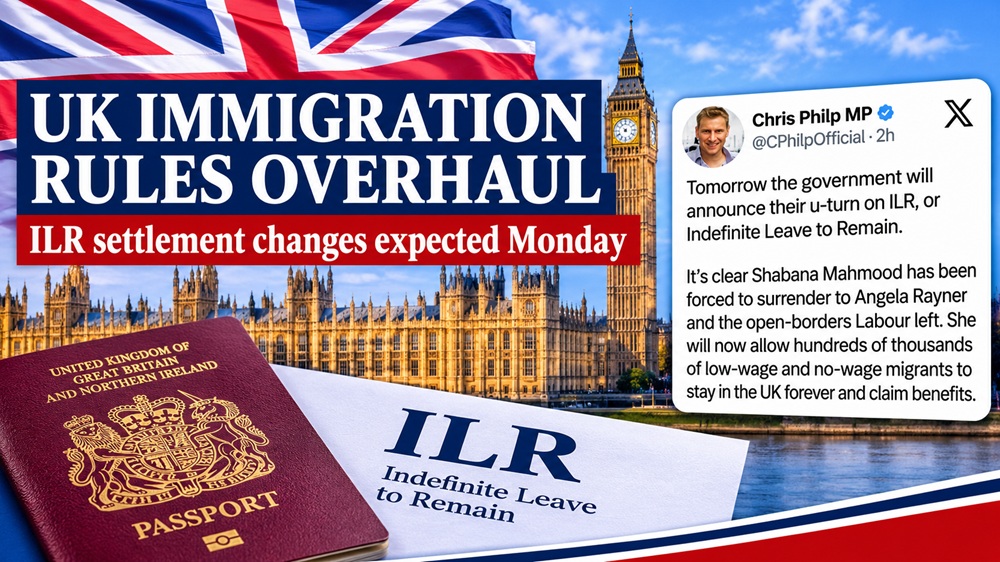
LONDON November 1, 2026: Home Secretary Shabana Mahmood is expected to announce the Government’s final immigration reforms in the House of Commons on Monday, November 2, with proposed changes to Indefinite Leave to Remain (ILR) and settlement rules expected to be at the centre of her statement. According to ITV News, the announcement could confirm significant changes to the length of time migrants must live in the UK before qualifying for permanent settlement.
The key proposals include:
Increasing the standard qualifying period for ILR from five to 10 years.
Extending the qualifying period to 15 years for some lower-paid workers, including care workers.
Introducing transitional exemptions for social care workers already living and working in the UK.
The announcement can be followed live through UK Parliament Live TV.
Possible concessions over care workers
Speculation has intensified that some of the most controversial proposals could be softened, particularly plans to extend the ILR qualifying period for foreign care workers from five to as long as 15 years. Reports suggest Ms Mahmood may exempt existing social care workers in the UK from the extended settlement timetable, potentially limiting the changes to future arrivals.
The proposals have exposed divisions within the Government. Housing Secretary Angela Rayner earlier this year publicly criticised the possibility of applying the new rules retrospectively to migrants already living in Britain. Then Energy Secretary Miatta Fahnbulleh also repeatedly declined to confirm her support for extending the settlement qualifying period.
Prime Minister Andy Burnham said last week that he strongly supported the principle that ILR was a “right to be earned”, although he stopped short of committing to implementing all of Ms Mahmood’s proposed reforms.
Government responds to immigration concerns
Ms Mahmood originally proposed extending the settlement period amid concerns about the number of legal migrants approaching eligibility following record levels of post-Brexit net migration under the previous Conservative government. The proposals attracted more than 200,000 responses during a consultation lasting almost a year. The Home Secretary is expected to outline the Government’s final position after considering the feedback.
The original reforms, announced in November 2025, proposed doubling the standard qualifying period for settlement from five to 10 years for most migrants, with the possibility of extending it to 15 years for care workers. However, the plans prompted opposition from a significant number of Labour MPs, who argued that the changes could be unfair, particularly if applied to people already living and working in the UK. Ms Rayner previously described retrospective application of the proposed rules as “un-British”.
Conservatives accuse Government of preparing an ILR U-turn
Shadow Home Secretary Chris Philp accused the Government of preparing to retreat from its original immigration proposals. Writing on X on Sunday, he said: “Tomorrow the Government will announce their U-turn on ILR, or Indefinite Leave to Remain. It’s clear Shabana Mahmood has been forced to surrender to Angela Rayner and the open-borders Labour left. She will now allow hundreds of thousands of low-wage and no-wage migrants to stay in the UK forever and claim benefits. By Mahmood’s own admission in a speech this March, letting low wage care workers alone stay forever will cost taxpayers £10 billion and be an ‘affront’.”
Mr Philp added that, after taking a tough position on immigration throughout the year, Ms Mahmood appeared to have lost control of the policy to Ms Rayner.
He also outlined the Conservative Party’s alternative approach, arguing that a 10-year route to ILR should be available only to higher-paid workers. He said no further low-paid workers should be allowed into the country and that those already in the UK should be required to leave when their temporary work visas expire.
£10 billion potential cost to taxpayers
In an immigration speech in March, Ms Mahmood said that between 2021 and 2024, the UK experienced levels of migration that it had previously seen over a period of four decades. She expressed particular concern about people arriving through the health and social care visa route. The Home Secretary warned that, without changes, approximately 350,000 lower-skilled workers and their dependants could become eligible for settlement and access to benefits over the following five years. Citing figures from the Migration Advisory Committee, she estimated that this could create a lifetime cost of £10 billion for taxpayers. The figures and potential financial implications have become central to the debate over whether the Government should extend the qualifying period for permanent settlement.
Reform UK warns against granting early settlement
Reform UK Treasury spokesman Robert Jenrick also criticised the possibility of allowing existing migrants to qualify for permanent settlement earlier than originally proposed. He said: “I can’t believe Burnham would be stupid enough to give British citizenship to 400,000 people just six years after they came here. That would cost us hundreds of billions of pounds if they stay forever. It would go down as one of the worst decisions in modern British history.”
What is Indefinite Leave to Remain (ILR)?
Indefinite Leave to Remain is an immigration status that allows eligible individuals to live, work and study in the UK without a time limit. People granted ILR are no longer subject to immigration time restrictions and may apply for public benefits if they meet the relevant eligibility requirements. The announcement on Monday is expected to clarify whether the Government will proceed with its proposed 10-year and 15-year settlement routes, and whether migrants already working in the UK, particularly in the social care sector, will receive transitional protection.