






- September 23, 2026
How Can UK Have a Nursing Shortage While Newly Qualified Nurses Struggle to Find Jobs? (Analysis)
By Nirmala Chandran
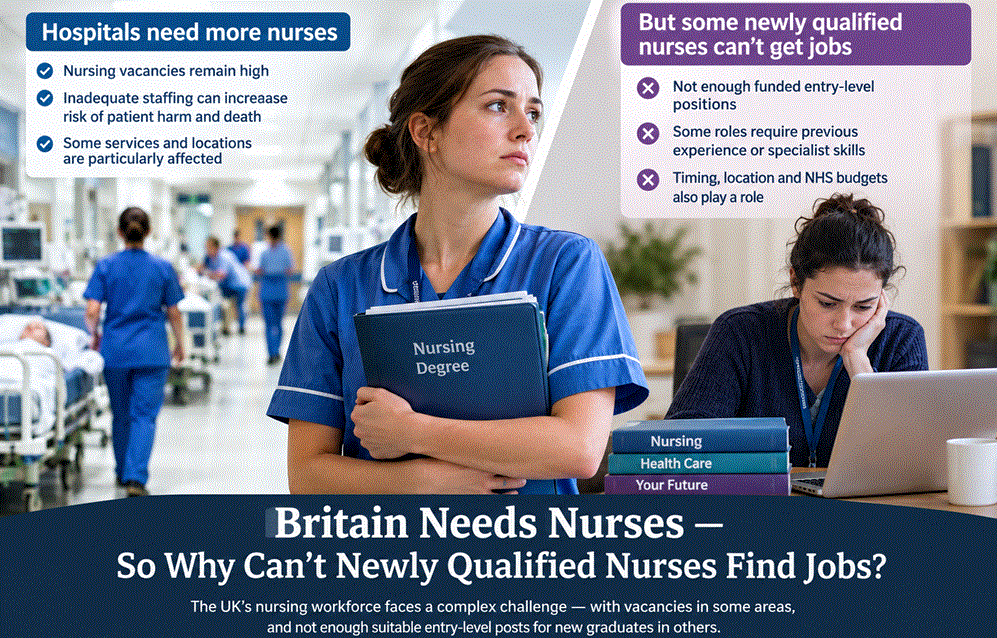
LONDON Sept 23: The UK’s nursing workforce appears to face a paradox. On one hand, hospitals and health services continue to report nursing vacancies and staffing pressures. Research has also linked inadequate nurse staffing with increased risks of patient harm and mortality. On the other hand, there have been reports of newly qualified nurses struggling to secure permanent NHS positions after completing their degrees.
At first glance, these two situations seem impossible to reconcile. If the NHS needs more nurses, why aren’t newly qualified nurses automatically being offered jobs? The answer lies in the difference between a general nursing shortage and the availability of suitable, funded jobs for newly qualified nurses.
A shortage does not mean every nursing vacancy is suitable for a new graduate
When people hear that the NHS has thousands of nursing vacancies, it is easy to imagine thousands of vacant Band 5 positions waiting for newly qualified nurses. The reality is more complicated. Nursing vacancies can exist in different specialties, locations and levels of experience. A hospital may need nurses for intensive care, emergency departments, specialist services or community nursing, where employers may require particular skills or previous experience.
A newly qualified nurse may therefore be unable to apply for—or be appointed to—many of those vacancies. For example, a hospital could have ten nursing vacancies but only three might be suitable for newly qualified nurses. The other positions could require specialist knowledge or previous experience. This means that the number of nursing vacancies does not tell us how many jobs are actually available to newly qualified nurses.
Experienced nurses and newly qualified nurses are not interchangeable
The NHS has historically relied on international recruitment as one component of its workforce strategy. Internationally trained nurses who meet UK registration requirements can provide an important source of experienced staff. That is different from employing a newly qualified nurse.
A new graduate normally requires a period of transition, supervision and development before becoming fully established in clinical practice. An experienced nurse who already has relevant clinical experience may be able to fill a specialist vacancy more quickly. Consequently, an NHS trust can simultaneously have a shortage of experienced nurses and a shortage of suitable entry-level posts.
The timing of recruitment also matters
Another important factor is the timing of university graduation and NHS recruitment. Thousands of nursing students qualify around similar periods of the year. NHS trusts, however, recruit according to their own workforce requirements, budgets and vacancies.
This can create a mismatch. There may be large numbers of newly qualified nurses looking for their first job at precisely the point when individual trusts have limited numbers of suitable vacancies. The UK government recognised this problem when it introduced a Graduate Guarantee for newly qualified nurses and midwives in England. The policy was intended to help graduates who were struggling to secure employment despite the NHS’s wider workforce requirements.
Funding and staffing establishments are part of the problem
Perhaps the most confusing aspect is that a hospital can experience staffing pressure while also restricting recruitment. This can happen because the number of staff required clinically is not necessarily the same as the number of permanent posts that a trust has funding and approval to employ.
A ward may be struggling because of sickness, annual leave, staff turnover, vacancies or increased demand. At the same time, the trust may face financial restrictions that limit the creation or filling of permanent posts. In other words: A hospital can be short of nurses without having an available, funded job for every nurse who wants one. This distinction is essential to understanding the current debate.
Why international recruitment can coexist with unemployed graduates
The question becomes particularly controversial when people see the NHS recruiting nurses from overseas while British-trained nurses report difficulty finding their first job. However, international recruitment and graduate recruitment are not necessarily addressing exactly the same problem.
International recruitment has often been used to fill particular workforce gaps, including positions requiring experienced nurses. A newly qualified nurse may be qualified as a registered nurse but still lack the experience required for some specialist positions. There is also an important geographical factor. A nursing vacancy in one part of England does not automatically create an opportunity for a graduate living somewhere else. Similarly, a vacancy in mental health nursing, intensive care or community nursing cannot necessarily be filled by a graduate seeking a general adult nursing position in an acute hospital.
The numbers can therefore be misleading
Two statements can both be true: “The NHS has a shortage of nurses.” and “Some newly qualified nurses cannot find NHS jobs.” The apparent contradiction disappears when we look at what is actually being measured. The first statement generally refers to the overall workforce requirement, vacancies, staffing levels or shortages in particular services. The second refers to the availability of suitable entry-level positions for newly qualified nurses. They are related, but they are not the same thing.
The bigger issue is workforce planning
The underlying challenge is how the NHS plans the supply and demand for nurses over many years.
The system has to anticipate:
- how many nurses will retire;
- how many will leave the profession;
- how many existing nurses will remain in the NHS;
- how many students will qualify;
- which specialties will require more nurses;
- where those nurses will be needed;
- and how many permanent posts NHS organisations can afford to fund.
If these factors are not properly aligned, the NHS can end up with a peculiar combination: staff shortages in some parts of the health service and unemployed or underemployed newly qualified nurses in others. That is why simply increasing the number of people studying nursing does not automatically solve every staffing problem.
A more accurate description of the situation
It is therefore too simplistic to say either that “the UK has no nursing shortage because graduates cannot find jobs” or that “there are thousands of nursing vacancies, so every graduate should have a job.”
A more accurate description is: The UK has nursing staffing shortages in particular services, locations and experience levels, while at the same time some newly qualified nurses face a shortage of suitable entry-level permanent positions. The issue is therefore not simply how many nurses the UK has. It is also about where those nurses are needed, what experience they have, what jobs are funded, and how effectively NHS workforce planning matches the number of graduates with future vacancies. That distinction helps explain why a newly qualified nurse can be looking for a job at the same time that a hospital ward is struggling to maintain safe staffing levels.