






- September 16, 2026
South America: A Long-Delayed Adventure Begins in Quito
By Dr Chitra Gopinathan
Chitra Gopinathan is a Consultant Anaesthetist working at Queens Hospital in Romford. Her hobbies and passions are varied. She enjoys the creative side of herself. She attempts a bit of writing and drawing when she gets the chance and feels inspired. She has a blog site, ‘Chitra’s musings’ at gchitra.com. Although it was a regular feature, it has now become a bit adhoc as she puts it. She enjoys reading, travelling and eating out.
I had a bucket list once upon a time and it evaporated somewhere along the way. Then Kanthi went to South America and on her return said “if you are going to do it, don’t leave it too late”. That was two years ago. So here we are finally in Quito after a very long journey, tired and jet lagged. Our guide passes us two water bottles as soon as we get in the taxi. “Keep well hydrated,” he advises, “to avoid altitude sickness”. Quito is situated in the highlands region of Ecuador. The taxi starts climbing uphill and about an hour later comes to a stop near our hotel in the Old Town. It is only early evening but with a time difference of six hours behind London, we are too tired to venture out and instead relax in the hotel lobby watching Ecuador draw with the Curaçao team.
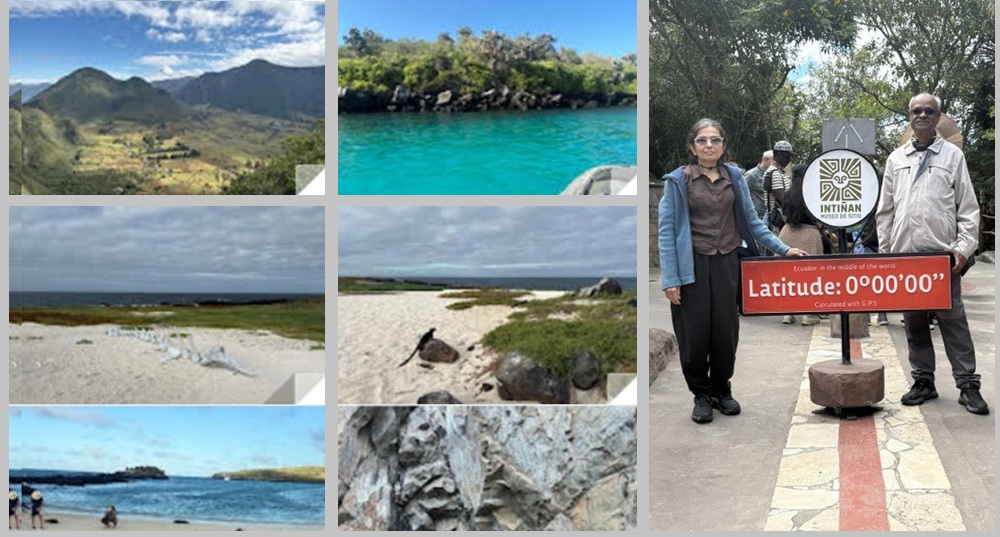
Sunday, and Clara arrives at nine to give us a guided tour of Quito. Quito is a long but narrow city which winds its way between the Andes Mountains. It is Father’s Day and for us in England the longest day of the year but here in Ecuador the sun rises and sets at relatively the same time between 6 and 6.30 in the mornings and evenings throughout the year. The reason for this will become apparent at our next stop but first we have a brief stop at Pululahua Geobotanical Reserve, an inhabited volcanic caldera. The last major eruptions occurred over 2000 years ago and it now resembles a lush valley where people live happily. Fumaroles can still be seen giving off fumes but the danger of an eruption is negligible, we are told. After midday thick fog covers the area and so one needs to get here early to get the best views. The guided tour at the Equator point starts at Rita Caiza‘s original house which is situated just a few yards from the equatorial line and is preserved as a museum.The kitchen houses a breeding area for guinea pigs as it used to be in the olden days. These are the lucky ones which are treated as pets unlike their counterparts in the rest of the country. We are surprised to learn that there were guinea pigs in the room as we hardly heard a squeal. The guide tells us that if they stay quiet it means that our group has projected a good vibe. Probably they realised that none of us have any intention of eating them and they didn’t have to worry. The guide explains the ancient rituals of the Amazonian tribes and how enemies were treated after they were slaughtered. The skull and brain were removed from the head, leaving the skin intact and then through various processes the skin was shrunk down to the size of a fist and kept as a trophy and cover for their spears. There is an original one on display at the museum. Ecuador takes its name from the equator and although the equator passes through several countries the reason it is important here is because of the high altitude which makes it the highest point where the equator is closest to the sun, although this actual point is on the summit of Chimboraza, which is south of Quito. On clear nights the stars from the northern and southern hemispheres can be seen from Ecuador. After the excitement of standing on the line with one foot on the southern and the other on the northern hemisphere it is time for a well-earned lunch break. Ceviche followed by a fish main and then fruits dipped in chocolate and I am full. I am not sure I can walk around the old town after such a heavy meal, but Clara assures me that it is a gentle walk. The square is teeming and performers are strutting their stuff. Street vendors are busy selling a kind of fruit meringue in ice cream cones and the intense afternoon sun has no effect on this fake gelato. La Compañia Church, a baroque marvel where construction began in 1605 and took 160 years to complete, has an interior completely covered in gold leaf equivalent to 60 kilograms of gold. Part of this was destroyed in a fire and later restored. The new gold covered areas expose the contrast between the old and restored sections and at the same time makes you wonder how dazzling it would have looked when first completed. The tour was rounded off by a chocolate tasting session where we taste ten different varieties of mouth-watering chocolate followed by a chocolate brownie and chocolate drink. By now it certainly was time to put my feet up and watch the next World Cup game.
Early next morning we get picked up for our flight to Baltra Airport. We need to fill in an online declaration form stating that we are not bringing certain food items into the Galapagos, get a QR code and show it at the airport. At Guayaquil we remain on the aircraft while passengers disembark and new passengers get on and we are off to our destination in the Galapagos. The airport we are flying to is Baltra Island (also known as South Seymour) which looks uninhabited with an arid landscape. Once we leave the aircraft and go through the usual checks our luggage is unloaded and a police dog does a thorough sniffing exercise to detect any suspicious food items. On completion he gives us the all clear and we are free to collect our bags. Fabricio, our guide, is waiting for us and there are fifteen of us on this leg of the tour. The group consists of Australians, Americans, a Croatian lady, a German lady and another lady from Manchester. The time is one hour ahead of mainland Ecuador and the afternoon sun is relentless. It is time to shield ourselves from the UV rays and we reapply the sun cream and take out our hats and jackets.
After a short ride to the dock we get on a boat to cross the Itabaca Channel to reach Santa Cruz Island. Some school children get on the bus. They are celebrating the end-of-year exams with a trip to the island and a youngster sitting next to me strikes up a conversation. She is Spanish and practising her English and asks me what other languages I can speak. I am impressed with her enthusiasm and tell her that I’ve been trying to learn Italian but her English is way better than my limited Italian. On reaching the island we get on a van which takes us to the cloud forest in the highlands. The vegetation changes colour as we climb the hill and the arid landscape soon turns lush and green. Santa Cruz is one of 4 inhabited islands in the Galapagos, all of volcanic origin. The youngest islands are less than one million years old, while the oldest are around three to five million years old. Fabricio with his background in engineering and geology explains how islands sank and new ones were formed. Our first stop is a farm for lunch. The farm doesn’t breed tortoises but the giant tortoises of the island are drawn to this place for some reason. They graze all day long getting through tons of vegetation and are important for the welfare of the ecosystem. Different islands and volcanoes developed their own endemic tortoise species. The estimation was that there were 200, 000 to 300,000, however only 20,000 to 25,000 remain today. One of the reasons for this is the introduction of animals such as goats, cattle, rats and feral cats onto the island. The Galapagos conservation program has managed to eradicate goats and rats completely from some of the islands but in the inhabited ones people still keep goats. We learn how to identify tortoises more than 80 years old and their gender. We also take a walking tour through a lava tunnel which was formed from flowing molten rock. After a free hour at the port and our last chance of shopping for the next four days we wait for our panga boats to take us to our yacht. A lone sea lion is dozing on the pier happily and it gives us a glimpse of what to expect in the coming days. Fabbricio explains the safety drill and our itinerary for the next day. After dinner we settle into our cabins and the boat sets sail. We are rocked to sleep as it sways in the current.
Second day in the Galapagos: North Seymour Island and Mosquera islet
Our first stop after breakfast is North Seymour island. A swallow tailed gull is nesting on pebbles near the steps from which we climb after our dry landing onto the island. Nearby another gull brings food for its chick and passes it over to the mother bird. It’s a squid or octopus and the chick frantically tries to peck on it. The gull needs to be wary of the frigate birds which are opportunistic creatures. These birds like to take the easy way out and snatch hard earned meals from other birds and even nesting materials. The mother bird swallows it whole and will regurgitate it later for her chick.
We have been given instructions to always stick to the tracks behind our guide and observe the two metre rule with the wildlife. We are in their home territory, need to respect their boundaries and help preserve the ecosystem. If a booby bird or iguana wanders onto the track, we give them a wide berth as we pass them. The ecological relaxation the wildlife exhibits let us observe them at close quarters while they go on with their lives. It is the mating season for the blue footed booby birds and the male species need to attract the attention of the females. We catch one in the process as it waddles slowly around the female bird stomping its webbed blue feet assuredly on the ground, each time hoping that this would be the instant that she falls for his charm. However she is a stubborn one and snubs him pointing her beak in the opposite direction as he circles her. We stand there encouraging him and telling her to go for it but she’s having none of it and he finally gives up and wanders off.
Next we see a male frigate bird with its red throat puffed up, flapping his magnificent black wings and doing his best to attract a mate. Lava lizards dart across our path and we spot frigate birds nesting with their young ones and in some nests there are chicks with no parents guarding them and all this within arms reach. Black marine iguanas are the only iguanas which can swim and they can be seen crawling the black rocks near the shoreline. It is time to get back to our boat and get ready for our morning snorkel session.
Snorkelling gear is provided on board but I bought my own and have been practicing. I have snorkelled in the past but panicked the last time I did it in Mauritius and so have come prepared this time. The waves are choppy and Fabricio assures me that he will look after me but I am still a bit wary. Once I finally let go off the panga boat I feel better and calm down. A turtle swims past and so do shoals of colourful fish. The visibility is not that great but still enough to get good views. We swim around the coast as the panga boat follows us keeping an eye as does Fabricio. Over half an hour later it is time to head back.
After lunch we visit Mosquera islet which is located between the islands of North Seymour and Baltra. The islet is home to one of the largest colonies of sea lions in the Galapagos. Here we have a wet landing meaning that we step off the panga boat on to knee deep water rather than dry land as this is as far as the boats can take us. The sand is pristine white with the sea lions lazing along the beach. The mothers are having a well earned rest after their swim and feeding expedition while their pups suckle. We watch baby sealions rushing to greet their mothers as they emerge from the waters. They call each other and smell each other to make sure they’ve located their correct pair before settling down. We also see lost pups frantically going from one sealion to the next trying to locate their mother and being shooed away by either the mother or pup. If the mother doesn’t return from her feeding expedition the pup dies and during our trip we see a couple of pups on their last legs. No one is allowed to intervene with nature. The alpha males patrol the beach to keep the sharks away and to prevent the pups from venturing into the sea. Their numbers depend on the size of the colony. Sally Lightfoot crabs and marine iguanas can be seen resting and scrambling amongst the rocks and sand. Not far from the action the bleached skeletal remains of a beached pilot whale can be seen lying undisturbed where it was stranded. This background with turquoise warm waters, white sandy beach and approaching sunset gives the impression of tranquility but wherever there is a breeding colony of sea lions there are sharks circling not too far away and we spot them at night circling our boat.
Third day: Darwin Bay, Genovesa Island
The day starts off with a snorkelling trip to see the hammer head sharks. The sea looks rough more so than yesterday and is lapping against the cliff’s rocky face and I give it a miss. The group that goes are lucky enough to spot a couple of sharks. When they return we make our way to Darwin bay which also has a sea lion colony. We spot the red footed booby birds this time and Fabricio explains the difference. The three types of booby birds are the blue footed, red footed and Nazca boobies which have grey feet. They differ in their mating rituals, number of eggs they lay and structure of their feet. The differences evolved depending on the feeding habits which is determined from how far from the shore each species gets their food. After the walk we get a chance to snorkel from the beach to the deeper side with more fish and in the shallower side of the beach with the sea lions. The sea lions we see here are the descendants of the Californian sea lions but are much smaller versions and as a result a more cuter variety. The time spent swimming with the sea lions provided a lot of entertainment as some chased us and others interacted with us. It was difficult maintaining the two metre rule and the sea lions seemed to be having as good a time as we did. No one wanted to leave but it was time for lunch and we had to head back.
There was a chance to kayak in the afternoon but there were only three kayaks with space for two people in each. Although I had taken a lesson beforehand I didn’t feel brave enough to kayak in the sea. The rest of us stayed in the panga boat and circled Darwin bay spotting marine iguanas swimming this time, a different type of sea lion which has arrived from the southern hemisphere nestling in the ledges of the cliff and lava herons trying to fly back to their homes in the cracks of the cliff and failing and needing several goes before landing safely. Once the kayaking session ends we spend the afternoon walking around Genovesa island and this time it is the Nazca booby birds we see. A male is nesting and when he stands up we can see two eggs. Next to him a couple is engaged in a mating ritual. The male normally starts building the nest with small sticks and stones to attract the female. If he is not successful he leaves the partly built nest and moves on. We saw a few such abandoned nests during our walk. In this instance however the female likes the nest and has decided to join him. She stands tall while the male scampers around gathering a stick here or a pebble there and brings it to her. If she approves he lays it on the nest and if she doesn’t she shows her annoyance by flipping it away. Further down the beach among the rock formations one of our group spots an owl and passes his binoculars around.
Fourth day: South Plaza Island and Santa Fé Island
After a dry landing on South Plaza island we follow the trail up to the cliff. The land is dotted with prickly pear cacti and the ground covered with a low-growing sesuvium which turns from green to orange and then red during the dry season by shedding their chlorophyll. The process is not quite complete yet but as the sun comes out the reddish hue becomes more visible. Fabbricio explains how the different islands have their own different varieties of cacti. In some islands the cacti have shed their prickly thorns and a fibrous strand has taken its place. This adaptation is to let the finches feed on them without getting hurt. Just like the cacti have adjusted over the centuries, the Darwin finches have evolved to have different shapes and sizes of beaks in accordance with their feeding requirements. At the cliff top Fabbricio asks us if we notice anything different about the smell. This is where male sea lions who have not managed to find a mate come to grieve. First they need to negotiate the steep climb to reach the cliff top. Once here the exhausted and depressed sea lions stay for an average of 3 weeks to get over the heartache before going back down. In the distance we can see a few sea lions dotted along the cliff. Fabricio tells us that one can see the sadness in their eyes. The air is scented with a smell that I later recognise and one which lingers on my shoes which I have been using for my wet landings.
After lunch we head off to Santa Fé Island, where we have a wet landing and once again meet a large colony of sea lions. From here we walk along a rocky terrain to the next beach. Fabbricio has forgotten his footwear and we wonder how he is managing this path. A group of tourists coming in the opposite direction thinks he is a brave man. The Galapagos authorities determine when and how many boats can dock at each island at any given time and thus are able to limit the number of people on an island. Along the way we see Opuntia galapageia, a huge cactus characterised by its large trunk, which is thought to be an adaption that protects the plants from iguanas and the now extinct Santa Fé giant tortoises. The iguanas we see here are yellow in colour compared to the ones we saw previously on Genovesa island. This is related to the yellow vegetation they consume. At the beach we once again admire the sea lions. One young pup chases after us. After a while he gets tired and lies down next to another pup who is also waiting for its mother to return from the sea.
Fifth and final day: Witch Hill, San Cristobal Island
Before we leave for the airport on San Cristobal island we are taken on a panga boat ride around Witch hill and Kicker rock, an eroded volcanic cone in the Pacific Ocean. As the panga boat navigates its way around the rock Jordan, who is in charge of our boat, takes us into the rock crevices and this gives us some stunning views of the high cliff faces which have eroded with time. It is almost time to head to the airport and say our goodbyes to Fabbricio, the boat crew and our fellow passengers. We have a couple of flights to catch before we reach Lima with a few hours layover time in Guayaquil Airport where we pass time watching football matches. It is late in the evening when we reach Lima airport and the immigration queue is huge. One of the staff asks us if we are senior citizens and directs us to a queue with hardly anyone in it. I have never been more happy to be acknowledged as old than at this point as we breeze past security, collect our luggage and head out to where our guide is waiting for us to take us to our hotel.
Lima
Breakfast in the hotel is a bit of a letdown but we needn’t have bothered as we have booked a food tour and for the next five hours we are taken on a historical and culinary tour around the capital of Peru. The first stop is for a taste of organic Peruvian coffee and a delicious breakfast burger at a caffe not far from our hotel and overlooking the ocean. A little yellow bird with a red face pecks at crumbs near my feet as Artur explains Peru’s biodiversity, climate and how and why Peruvians are able to cultivate over 4000 different kinds of potatoes, different coloured corns, peppers and tomatoes of different sizes, shapes and colour. We have an American couple and Dutch dad with his two grownup sons in our group. Invariably the conversation turns to football. After breakfast we stroll around the Barranca neighbourhood where giant art murals don walls and art shops are a plenty. We learn about the artists and the interpretations of the murals. Before the drive to the local market we stop at a caffe bar for a smoothie made of lumuca fruit mixed with milk, and it is the creamiest silkiest sweetest smoothie I have ever had where no sweetener has been added. The exotic local fruits and vegetables on display at the market are the likes of those I have never seen before in terms of their size, colours and shapes. We get a mystery box of different fruits to taste. Next stop is a restaurant with a bar where the barman shows us how to make pIsco sour, the local alcoholic cocktail, following this the chef teaches us how to make ceviche although the preparation work is already done and we just need to mix the ingredients and of course eat it. Our next and last stop is in the Miraflores suburb at a Peruvian restaurant overlooking the pre-Incan ruins of the Huaca Pucllana. A three course meal follows. Every single item is delicious and not much remain on our plates by the time lunch is over despite the fact that we’ve been eating all morning. I can understand now why Lima is one of the major food capitals of the world with some of the world renowned restaurants. We are dropped off at the shopping mall at our request and after wandering around the mall we take the cliff walking path back to our hotel. We had time to visit local museums and churches but the traffic can get quite busy and we have a restaurant reservation in the evening and didn’t want to miss our slot by getting stuck in the traffic. Later in the evening at ‘Siete’, we try the tasting menu and once again are not disappointed at what is on offer. We are flying to Cusco tomorrow and the advice is to eat light and drink plenty to avoid altitude sickness, something which is quite difficult to stick to if you are in Lima.
Cusco:
Next morning we fly to Cusco. At Cusco airport we bump into a retired Indian CEO from Chennai who is here with his wife and another couple. We exchange stories about our trips as we wait for our luggage which takes some time to arrive. Saiber and Ugo, our guide and driver for the next 5 days, are worriedly waiting for us outside when we finally collect our luggage and meander out. It is a long drive to Ollantaytambo but we stop off at a couple of places on the way. Once again the Andes mountain range surrounds us on the journey. The first stop is the experimental agricultural terraces of Moray. These are two large and one small circular agricultural terraces carved into the shape of bowls dating from the Inca period, probably the 15th century. Each level has a different microclimate and there is a temperature difference of 15 degrees centigrade between the top and bottom terraces. The crops were gradually moved from the lower altitudes to the top tiers and using these techniques the plants became accustomed to the higher altitudes. Similar terraces can be seen all across the mountain ranges of the Sacred valley but this is the only place where they are seen in circular forms and where maize was transformed into a high altitude crop.
A few kilometres from here we visit the Maras salt pans, which have been in use since Inca times to extract salt from natural mountain springs. Our first glimpse is from the road, where we get the best views of the salt pans in its entirety. It is not clear where the salt originates from or how long the supplies will last. The water is diverted into each platform and left to dry. Once dry the surface is scraped to get the purest salt first for culinary purposes and the rest separated for other purposes. Once emptied the platforms are refilled and the process is repeated. All the work is done manually. Extracting the salt from each platform and transporting it is not an easy job and seems to be a dying profession with the younger generation not having much of an appetite to take on the job.
At Ollantaytambo we check into our hotel where we will be for the next three days. The hotel is less than five minutes’ walk to the train station from where we will catch the train to Machu Picchu in a couple of days but for now we need to get acclimatised to the altitude to avoid altitude sickness. Cusco, however, is at a higher altitude than Machu Picchu.
Next day at breakfast the waitress mentions that it is a special festival day for them. During the months of June and July various Inca festivities are celebrated in and around the Sacred Valley. Saiber and Ugo pick us up for our morning trek. The town is buzzing with locals from neighbouring towns arriving for the festival wearing colourful traditional costumes and I see some men wearing feathered headgear. Ugo drops us off near the Pumamarca ruins in Patacancha Valley. From here we climb steep steps to reach the ruins taking regular breaks to catch a breath. Saiber explains the Legend of Ollantay and his forbidden love story behind the origins of the fortress. After walking around the remains of the fortress we start our slow trek down along an Inca trail to our pick-up point where Ugo will be waiting for us. The path is slippery at times with loose stones. The whole trail is about 5 kilometres long and takes us around three hours. Normally a walk of this length should have taken less than an hour to complete but the altitude and terrain are against us and we take our time. Along the way Saiber points out herbal plants used for medicinal and cooking purposes. We stop to smell the coffee, mint and coca leaves. Eucalyptus was brought here from afar and have now taken over entire landscapes destroying the native plants. With the Andes mountain range and valleys surrounding us, and American kestrels circling the skies, the views from the agricultural terraces are breathtaking. A group of American students approach us from the opposite direction. They’ve taken the difficult route, climbing uphill whereas we are going down.
Once back in the car we drive back to Ollantaytambo and the archaeological museum. The roads are crowded due to the festivities. Actors, male and female, are dressed in their traditional Inca costumes and getting ready to re-enact ancient rituals. Music fills the air as the actors line up to perform their part before the Inca emperor, another actor, is welcomed into the city. We watch the ceremony from the Inca steps as we climb to the top of the fortress listening to Saiber’s stories. Defence was high on the list of priorities for the Inca civilisation with these fortresses built to keep an eye out for invasion and in places where life can be sustained with natural flowing water. The boulders weighing tons used for building the fortress had to be brought here from elsewhere and the remnants of the ramp along which they were hauled up can still be seen. Once we are down and back on normal terrain, I look up and wonder how I managed to do the steps. Height and I are never the best of companions. After lunch we have a free afternoon to wander the streets and visit the souvenir markets selling handcrafted items. Although the daytime is hot the temperature drops by nightfall and we need our jackets.
Early next morning Saiber picks us up for the short walk to the station to catch our PeruRail to Machu Picchu. The Inca train scheduled before our train was about to leave as we reach the station and musicians fill the chilly air with tunes to ramp up the excitement. We don’t have any such fanfare when we leave about half an hour later. Our entertainment is reserved for the return trip Saiber tells us. The train weaves around the Andes and before our final stop it stops to let off those who are hiking up the final 11-12 kilometres. Once we reach Machu Picchu we wait in the queue for the 10 am bus. Everything is well organised and we are only allowed to board the bus and enter the citadel site at our specific time slots. The bus winds its way along the narrow mountain road giving way in between for the returning buses. At the top we alight and once again queue up for our route 2 tour at ten am. I was worried about the heights and lack of handrails to steady me but the fears were unfounded although there are quite a few steps to climb to reach the point from where the view of the citadel opens up. It’s another hot and humid day but bearable and the views are clear. Saiber explains how Hiram Bingham during his expedition and search for the lost city stumbled upon a young boy whose family was using one of the houses in the citadel as their home. He guided Bingham to the citadel. This was in 1911 and Bingham brought it to international attention. The site was covered in vegetation and has since been gradually restored. After posing for and taking the usual tourist photos we start climbing down and follow our designated route with Saiber. He explains why this region was chosen to build the citadel and along the way shows us where the royalty and the rest of the community lived, the sun temple, water channels and so on. The walk takes around three hours and after lunch we do the route 3 tour which covers the rest of the area. At one site he shows us how the massive granite blocks used to build the citadel had fallen off a nearby mountaintop and how they were carved, stacked up and joined together to build the complex. This second walk only lasts an hour and we catch our bus back to the station. With an hour to kill before our train trip back we order a pisco sour each and watch France play the Swedish team. As Saiber mentioned there was music and dance on the Vistadome on the journey back with more pisco sour and souvenirs handed out to take back home. Dinner tonight is at the train station restaurant. The meal portions are huge and I can normally only finish a starter and have stopped ordering main meals. Quinoa and potato dishes are aplenty along with fish, pork and chicken. I steered clear of cuy (guinea pigs). Rodents are still rodents regardless of their cute appearance.
The next morning we move from Ollantaytambo to Cusco city. On the way we stop off at Pisac to see more Inca ruins. Saiber tells us that this is his favourite Inca spot. As we near our destination we make a pit stop at a lookout point where symmetrical terraces are carved into the entire mountainside. There are over 500 terraces here and it is a sight to behold. At the Pisac ruins site locals have set up stalls on either side of the road and try to entice us to buy their fruit juices and craft products. In the citadel there is an enclosure with alpacas. Here tourists are trying to take selfies with them as they continue with their grazing. The most interesting sights at the Pisac ruins are the burial chambers which can be seen dotted along the nearby cliff. The dead were mummified in a sitting position and once the process was complete they were taken up in woven baskets to be placed in this cliffside necropolis, where the burial chambers were then sealed. The higher the person’s rank the more elaborate the wall sealing is. There are estimated to be almost 10,000 burial chambers here. Few of the mummies have been excavated and can be seen in the Inca museum in Cusco. Before we are dropped off at our hotel in Cusco we visit the Pisac market. Another colourful market selling souvenirs and apparently this is the place to buy the purest form of silver jewellery. There is a public oven in the centre of the market where the locals bring their food to be cooked. This is also the place to get the best fresh empanadas. Ugo has already asked Saiber to get him a couple but couldn’t wait for them. He’s waiting near the oven by the time we get there. We also get one each and the baker warms them up for us and they are delicious. The streets in Cusco are narrow and Ugo cannot stop for long, so they drop us off at the hotel and leave. We have the afternoon to walk around the main squares which are all within walking distance of the hotel but the walk is downhill and then a steep trek up to get back.
Next day Saiber arrives early to take us around Cusco. Once again we visit more Inca sites. We see an operating room with a stone table carved into a rock. We are told that the table was used for surgical procedures such as trepanation . Some of the people even survived the surgery and the skulls are on display at the Inca museum which we visit later. Bone growth can be seen around the trepanation holes. At the Inca site of Sacsayhuaman we marvel at the engineering feat and megalithic mortarless stone walls. The tour ends at the Santo Domingo Church and the Cathedral on the Plaza de Armas after a brief stop at the San Pedro market. We say farewell to Saiber and have another half a day of free time to wander around the city. We stop off at the Inca museum to see the embalmed mummies on display and various artefacts that have been collected over the years before trying our luck at Morena restaurant where I couldn’t get a dinner reservation online. They were able to accommodate us and we enjoy a lovely lunch overlooking the main square from our window-side table.
Amazon rainforest:
Ugo arrives early next morning to take us to the airport and we are on the last leg of our South American adventure. This time we are flying to Puerto Maldonado. As the flight reaches our destination and starts descending the view of the Madre de Dios river opens up. It is a massive muddy serpentine river which cuts its way through the Amazon forest. Soon we will be on a canoe along one of its tributaries making our way to our next accommodation but first we are taken to the lodge’s headquarters where we leave our luggage and take only what we need for the next three days. A taxi takes us to the canoe site. The trip is almost an hour and a half long and the guide hands out our packed lunches. Rice with plantain and chicken wrapped in banana leaves. He tries to explain how we need to open and eat it when I interrupt and say this how we used to take our school lunches a very very long time ago. Everything is done in an environmentally friendly manner. There are no plastic wraps or plastic cutlery. The first part of this ride is along a paved highway and the second half through a bumpy unpaved dusty road through the forest with only occasional signs of inhabitation. At the canoe site we join our fellow travellers who have been waiting for us to join them. Our flight was delayed otherwise we would have got here at the same time. On the canoe we don our life jackets and take our seats. Once the canoe has started we are not allowed to walk around or move seats. The trip along the Tambopata river is around an hour long. On the way we stop to see caimans and peccaries. Caimans belong to the alligator family but are much smaller. The ones we see are yellowish grey in colour and blend in with the sand they are resting on. Peccaries resemble wild pigs. The difference between the animals here and those in the Galapagos is that the animals here scatter as soon as they spot us. Once we reach our lodge we disembark and climb over 160 steps to reach the top. The number of steps depends on the water level and as the water level is low at the moment we have to climb the full length and then walk for another 10-15 minutes to reach Refugio Amazonas which is situated on private land in the buffer zone of the Tambopata National Reserve.
It is late evening and though there are guided night walks we can do, we take it easy and attend the evening lecture instead. The talks are usually half an hour long and the young researchers explain the projects they are running at the nature reserve. The talk today is about moths and butterflies. There is a moth project we can get involved in and if we discover a new species it will be named after us. A few examples are cited.
The Argentina, Cabo Verde game is on and it looked for a while that the underdogs might just pull it off and the defending champions were going home, but they came through in the end. After dinner we retire to our dwelling, which is built on stilts and has no wall on one side and is open to the forest and elements but is very safe. The mosquito nets are down and tucked in and it is time for sleep.
Next morning we have a very early start and had to be on the boat before 4 am for our two hour trip to Collpa Chuncho to watch the macaw and parrots licking clay off the cliff. The speed with which the boat is chugging along makes it quite cold, we are supplied with blankets and soon everyone is fast asleep. By the time we reach Chuncho the sun is rising and we wake up to see the rays dancing on the muddy waters and turning the horizon a golden hue. The boat is docked and we are given a folding camping stool each. We follow our guides who are carrying their telescopes. They find a spot to set up their telescopes and ask us to sit in a line. Through the telescopes we can clearly see the green parrots. The clay has certain minerals which are essential for the parrots and each group comes down every few days to get their fair share of the clay.
The macaws are gathering on the trees and they can be seen from a distance due to the colourful plumage but through the telescope we can identify 3 different types. The parrots leave once they have had their share and now it is the macaws’ turn to come down. Timothy, our guide, tells us that one of them needs to make the first move before the rest follow. Vultures can be seen circling and the macaws group together and scare them off. The macaws then wait but are reluctant to come down. This gives us time to have our breakfast which has been set up on a table further afield in the shade by the boat crew. I settle down on my camping stool with a hot cup of tea and reflect on how different this Saturday is compared to my usual Saturdays. Timothy tells us that in a few weeks we won’t be able walk along here as it will be covered in turtle eggs. Where we are sitting is actually a river bed but as the water level is low the area is dry. By eleven the macaws are still reluctant to come down and we get ready to leave. Timothy tells us stories about the macaw families and how they fly in groups and treat these meeting areas as a kind of coffee bar for the grown-up chicks to chat up their future spouses. On the boat ride back we see groups of turtles resting on floating tree trunks and more caimans lurking along the sandy beaches.
Late in the afternoon, we join our group for a walk to the tower. On the way we get a lesson on the Brazil nut trees and how the nuts are extracted from the fruit. The shell resembles that of a coconut and is similarly hard to crack open. During the monsoon season when the fruit falls from the trees the eco-lodge is closed to visitors to prevent injury. Brazil nuts are one of the major export products from the Amazon and these gigantic trees are closely monitored. The nuts are gathered by the local communities and processed and form a big proportion of their income.
For most of the common ailments and injuries the locals use forest remedies. Cuts are stitched together using soldier ants to bite across the wound and their mandibles used as staples. Sap from trees is used for healing abrasions. Certain herbal concoctions are used to get rid of worm infestations. Leaves from the carajuru vine when rubbed together make a bright purplish red face paint. Umbrella leaves are used to shelter from the rain. We see walking palm trees which use their roots to move away from the shady areas into the sunshine. I later find out that this is a myth and the tree trunks do not actually move. Timothy can detect animals from the scents they emit and he found capuchin, tamarin and howler monkeys hiding in the trees. The Tower is 30 metres tall and far taller than the tallest tree in the forest. Once we climb to the top we get a 360-degrees view of the forest stretching for miles in all directions and into the horizon. Macaws and toucans fly from treetop to treetop. It is almost sunset time and when it arrives it is another moment to behold as we watch the sun fade away behind the canopy of trees. Darkness falls and we make our way back to the lodge using our torches to light the path. The evening is spent listening to another lecture and watching a video. Today we are shown the various animals which have been captured on camera as they roam the forest, these include jaguars, tapirs and monkeys. I look up the difference between a jaguar and a leopard and realise that their coat patterns are different along with other differences. No two jaguars are alike either and from the shape of their faces and pattern of spots you can tell one from another.
Next morning after breakfast we join our group for the Oxbow trail walk. Once again Timothy points out interesting things along the way. We see a strangler fig tree which has strangled its host tree and now towers over the remnants. The trail takes us to Condenado lake, a tranquil cut-off part of the Tambopata river, here we get on to a small canoe with just enough rows in a single file for the nine of us and Timothy rows us around the perimeter. A flock of Hoatzins are resting on nearby branches hidden behind the swamps. A kind of strange brown hen-like creature with feathers arranged in a Mohican hairstyle, they flap their wings and fly from branch to branch. Timothy has brought some bread and passes it along as we sweep further ahead around the overgrown sedges and reeds. The water is the same muddy colour as its primary river but nearer the edges it is clear. We throw the bread chunks onto the water. Small and medium-sized piranhas jump up to catch the pieces. The sunshine is getting intense with no shade around us but the gentle breeze makes us forget the heat as we watch the fish gulp up the soggy bread. Once back on dry land Timothy takes us via another route back to the lodge. After lunch we get the boat and cross the river to visit a neighbouring farm. The owner has gone to the local market to sell his fruits. Timothy takes us around and we try the various exotic fruits that are growing in the garden. For lunch and dinner we are served different fruit juices each day and now we get to see the fruits they come from. Back at the lodge we listen to the final talk of our trip on Brazil nut trees and after dinner we settle down to watch England play Mexico. It was a tense game but England pulled through. A perfect end to a great holiday, hectic but well worth the effort. It was time to sleep and tomorrow we have to get the boat and bus to the airport for our long trip back home.