






- October 20, 2026
Documentary Revisits Extraordinary Life of Malayalee Scholar Who Served Sikh Empire
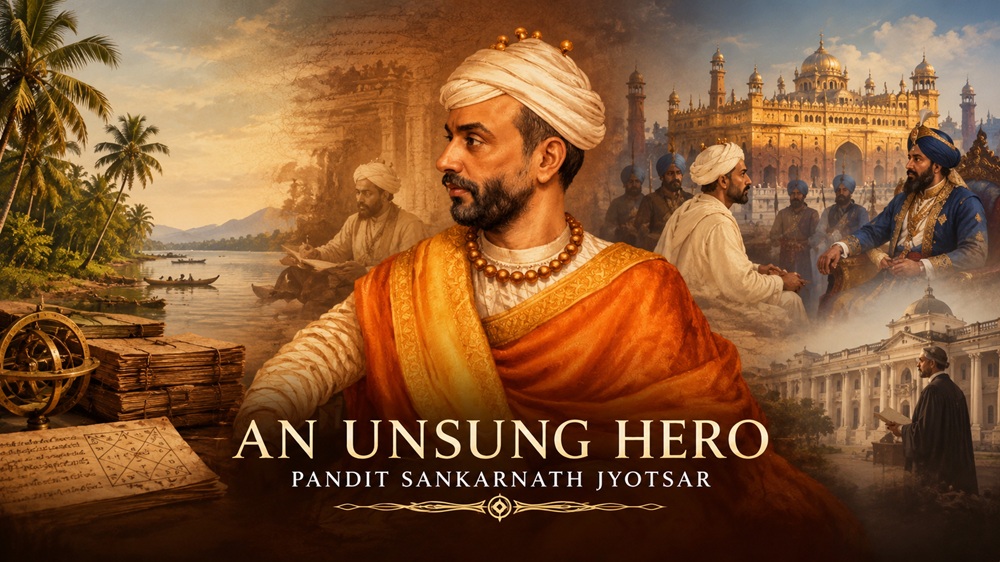
THIRUVANANTHAPURAM Oct 20: The documentary An Unsung Hero: Pandit Sankarnath Jyotsar brings to the fore the remarkable yet largely forgotten story of Pandit Sankarnath Jyotsar (1790–1858), a scholar from North Malabar in Kerala who rose to prominence as a royal astrologer, spiritual advisor, diplomat and court scholar under Maharaja Ranjit Singh, the legendary ruler of the Sikh Empire. The film chronicles the extraordinary journey of a Malayalam-speaking intellectual whose life connected the royal courts of northern and southern India, leaving a distinctive mark on the country’s intellectual, spiritual and cultural heritage.
Directed by filmmaker Late R. Sarath and produced by Deeta Nair and Ramesh, the documentary seeks to restore Sankarnath Jyotsar’s rightful place in India’s historical narrative and introduce his contributions to a wider audience. The film features a musical score composed by Ranjith Meleppat, with vocal contributions from renowned playback singer K. S. Chithra and singer Madhu Balakrishnan, enriching its historical narrative with a compelling musical dimension.
From North Malabar to the Royal Court of Lahore
Born on 16 July 1790 in Karivellur, North Malabar, Sankarnath Jyotsar, also known as Sankaranatha Jyothishi and Shankar Nath Joshi, developed an exceptional command of traditional Indian scholarship. He studied Sanskrit, the Vedas and Jyotisha, or Vedic astrology, in Benares, laying the foundation for a distinguished career that eventually took him far beyond his native Kerala.
His reputation for learning reached Maharaja Ranjit Singh, who invited him to Lahore. At the royal court, Sankarnath Jyotsar served as chief astrologer and became an important figure among the scholars surrounding the Maharaja. He also acted as a spiritual advisor, offering counsel within the political and cultural heart of the Sikh Empire.
His responsibilities extended well beyond astrology and religious guidance. He played a diplomatic role, engaging with British officials and accompanying the Sikh army on military campaigns. His involvement in court affairs and diplomacy distinguished him as a scholar whose expertise crossed regional, professional and cultural boundaries.
Judicial Service in Travancore
Sankarnath Jyotsar’s reputation also reached Maharajah Swathi Tirunal of Travancore. Recognising his learning and abilities, the ruler appointed him as a judge of the Sudder Court, the highest judicial institution in the Travancore kingdom.
He served in the position for eight years, demonstrating his capabilities in public service alongside his scholarly and spiritual pursuits. His transition from the royal court of Lahore to Travancore’s highest court reflects the esteem in which he was held across different parts of the Indian subcontinent.
His career offers a compelling example of how intellectual accomplishment could transcend geographical boundaries, connecting the cultural and political worlds of Kerala and Punjab during a period of significant historical change.
Contributions to Spiritual and Literary Scholarship
Alongside his royal, diplomatic and judicial responsibilities, Sankarnath Jyotsar made contributions to India’s religious and philosophical traditions. He authored works and produced respected commentaries on sacred texts, including the Njana Vaasishtam, Devi Bhagavatham and Gowree-thantram.
His scholarship encompassed Sanskrit literature, Vedic learning, astrology and spiritual interpretation. Despite the breadth of his accomplishments, his name gradually receded from public memory, particularly in the broader historical narrative of Kerala.
An Unsung Hero: Pandit Sankarnath Jyotsar revisits this legacy, exploring the intellectual depth and public service of a scholar whose life deserves greater recognition. Sankarnath Jyotsar passed away in 1858, leaving behind a distinguished record of learning and service.
A Family Tradition Continued Across Generations
The documentary also explores the lives and contributions of his son, Attukal Sankara Pillai, and grandson, Diwan Bahadur Justice Attukal Govinda Pillai. Through their literary, intellectual and social contributions, subsequent generations continued the family’s engagement with knowledge and public service.
By tracing this legacy across generations, the film places Sankarnath Jyotsar’s achievements within the wider history of Kerala’s intellectual and cultural development. It highlights how scholarship, social responsibility and a commitment to public life can endure beyond an individual’s lifetime.
Rediscovering an Overlooked Historical Figure
Drawing on historical research, archival material and an exploration of Sankarnath Jyotsar’s intellectual and spiritual world, An Unsung Hero: Pandit Sankarnath Jyotsar reconstructs the life of a figure whose career spanned scholarship, diplomacy, spiritual guidance and judicial service.
His journey from Karivellur in North Malabar to the court of Maharaja Ranjit Singh in Lahore, followed by his judicial appointment in Travancore, offers a fascinating perspective on the movement of knowledge, ideas and talent across nineteenth-century India.
Under the direction of R. Sarath, with Deeta Nair and Ramesh as producers and Ranjith Meleppat composing the music, the documentary brings together historical inquiry and cinematic storytelling. The vocal contributions of K. S. Chithra and Madhu Balakrishnan add further depth to its musical presentation.
By revisiting the life and achievements of Pandit Sankarnath Jyotsar, An Unsung Hero sheds light on an extraordinary Malayalee scholar whose life bridged Kerala and Punjab and connected diverse intellectual traditions of nineteenth-century India. The documentary also highlights the contributions of his descendants, presenting a broader account of a family’s enduring engagement with scholarship and public service.
Ultimately, the film serves as a tribute to a remarkable yet underrecognised historical figure, bringing his legacy to contemporary audiences and encouraging renewed appreciation of Kerala’s contributions to India’s shared intellectual, spiritual and cultural heritage.