






- June 13, 2026
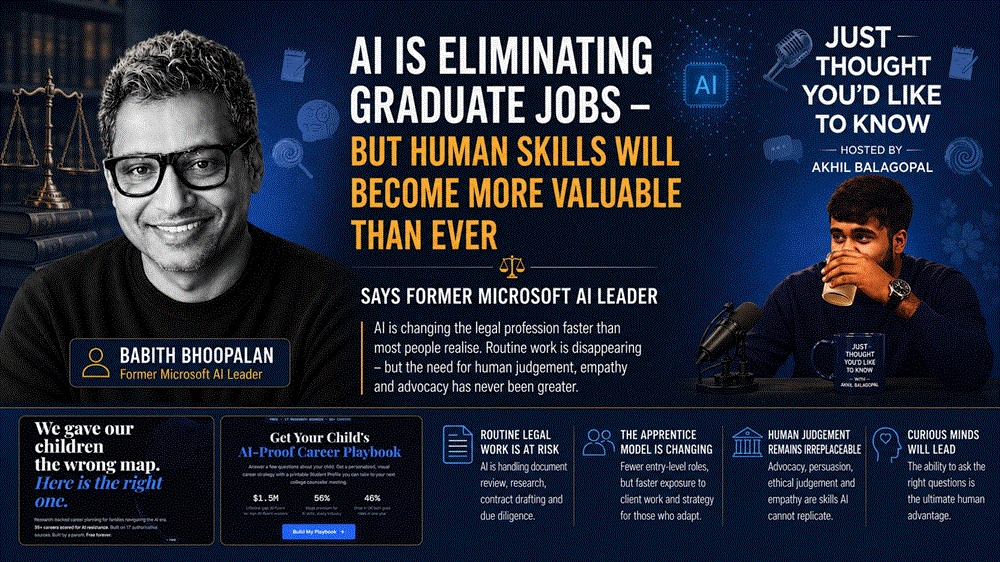
AI Is Eliminating Graduate Jobs – But Human Skills Will Become More Valuable Than Ever: Podcas
By A Staff Reporter
Babith Bhoopalan is a former Microsoft Technology Leader whose research into the impact of artificial intelligence on the future of work has sparked international conversation among parents, educators, and business leaders. Concerned about how rapid advances in AI could reshape career opportunities for his teenage daughter, Thea, he embarked on an extensive study of the jobs most likely to withstand automation.
Drawing on data from seventeen leading organisations, including the World Economic Forum and Goldman Sachs, Babith Bhoopalan developed an AI-career playbook that ranks professions according to their resilience in an AI-driven economy. His research identified four uniquely human strengths that remain difficult for AI to replicate: emotional intelligence, creative vision, physical dexterity, and ethical judgement.
His findings highlight careers such as mental health therapy, diplomacy, emergency services, skilled trades, and surgery as among the most AI-resistant, while also underscoring the growing importance of adaptability. Rather than encouraging young people to simply pursue “safe” professions, Babith Bhoopalan advocates developing fluency with AI tools alongside the critical human skills of communication, collaboration, critical thinking, and creativity.
Featured in The Sunday Times and discussed across major business networks, his work has become a practical guide for families navigating growing uncertainty about the future of employment. Speaking on the Just Thought You’d Like to Know podcast Babith Bhoopalan believes many of the entry-level roles that traditionally served as stepping stones into professional careers are quietly disappearing. Yet despite the alarming headlines surrounding artificial intelligence, Babith Bhoopalan remains optimistic. His message is simple: AI will change careers, but it cannot replace what makes us human.
CLICK TO VIEW AI Career Playbook Generator
CLICK TO VIEW Interactive AI Career Guide
Both are consolidating soon under aiready.family
Excerpts from Akhil Balagopal’s Just Thought You’d Like to Know podcast.
A Father’s Question Becomes Global Research
The origins of Babith Bhoopalan ‘s research were surprisingly personal. Rather than emerging from a boardroom or research institution, it began with a question from his teenage daughter. “I wasn’t acting as a technology executive,” he said. “I was acting as a dad.”
His daughter, now 17 and preparing to begin university studies in international relations in Washington, D.C., asked him how AI would affect her future career prospects. Babith Bhoopalan admits he did not have a satisfactory answer. Determined to find one, he embarked on an extensive research project examining the impact of artificial intelligence on employment and career development. What followed was a guide that has since been accessed by more than 30,000 families across 128 countries and featured in major international publications.
“It all started because I refused to give my daughter a bad answer,” he said.
Why Graduates Are Most at Risk
While public debate often focuses on whether AI will replace entire professions, Babith Bhoopalan argues that the more immediate concern is the erosion of entry-level opportunities. “The roles where the first year is mostly processing work are shrinking,” he explained.
These include jobs involving: Document review, Contract drafting, Routine legal research, Basic financial analysis, Administrative data processing. Artificial intelligence systems are increasingly capable of performing these tasks more quickly and at a lower cost than human employees. In the legal sector, Babith Bhoopalan points to growing evidence that AI tools are already handling work traditionally assigned to junior lawyers and paralegals. “AI is handling work that used to justify hiring a 22-year-old,” he said. However, he is careful not to predict complete job extinction. “When the internet eliminated certain jobs, it created others that nobody predicted. I suspect the same will happen here.”
The Legal Profession’s AI Reckoning
One of the strongest examples of AI disruption can be found within law firms. Major firms are investing heavily in AI-powered tools capable of reviewing contracts, conducting due diligence and carrying out legal research. The business rationale is clear.
“If AI can perform a first-pass contract review faster and at a fraction of the cost, the business case for large junior intakes weakens,” Babith Bhoopalan said. But he rejects the notion that this automatically spells disaster for young lawyers. Instead, he argues that AI may accelerate professional development. “The lawyers who are thriving are getting to the human work faster. They’re sitting in client meetings earlier. They’re involved in strategy discussions earlier. They’re building judgement earlier.” In other words, the traditional apprenticeship model is changing rather than disappearing.
The Jobs AI Cannot Easily Replace
While routine work is increasingly vulnerable to automation, Babith Bhoopalan believes careers built around human interaction remain relatively protected. He cites family law as a prime example. “You cannot write an algorithm for sitting across from a parent who fears losing access to their child,” he said. Similarly, criminal advocacy requires skills that extend far beyond information processing. “Reading a jury, cross-examining a witness and persuading people in a courtroom are performances of human judgement. AI cannot replicate that.”
The same principle applies across many professions where trust, empathy and interpersonal understanding remain central.
The Most Important Skill in the AI Era
Asked what single skill every young person should develop, Babith Bhoopalan ‘s answer was immediate: “The ability to ask better questions than AI can answer.” While AI has become remarkably effective at generating responses, it still struggles to identify which questions matter most. According to Babith Bhoopalan, future success will belong to those who can analyse complex situations, think critically and frame problems in meaningful ways. “Curiosity is becoming a superpower,” he said. For families, that means creating space for conversation rather than simply focusing on grades, qualifications or career titles. He encourages parents to discuss AI openly with their children, explore how technology is changing different industries and help young people understand both the opportunities and risks ahead. “Having a conversation may be the most revolutionary thing a family can do right now,” he said.
Fear Travels Faster Than Nuance
Babith Bhoopalan believes much of the public discussion surrounding AI has become dominated by worst-case scenarios. Every major technological revolution, he notes, has been accompanied by fears of mass job losses. “It happened with computers. It happened with the internet. Now it’s happening with AI.” The reality, he argues, is more complicated. “Every technology wave has disrupted jobs. But historically, it has also created new opportunities. The question has never been whether technology changes things. The question is whether people are prepared for what comes next.”
A Message to Young People
After spending nearly two years researching the issue, Babith Bhoopalan describes himself as “stubbornly optimistic” about the future.
His confidence comes from one central conclusion: the qualities that matter most in an AI-powered economy are deeply human ones – Empathy, Ethical judgement, Communication and Curiosity. The ability to make another person feel heard.
“The things that make you irreplaceable are not on an exam paper,” he said. “They’re not on your CV. They’re found in how you make people feel, how you show up when things get difficult and how you help others.” For students worried about the future, he offers reassurance.
“AI can answer questions at superhuman speed,” he said. “But it cannot be a human being at superhuman depth.” As artificial intelligence continues to transform industries, Babith Bhoopalan believes the ultimate determinant of success will not be technology itself but how individuals respond to it.
“The technology is the weather,” he said. “Your character and your choices are the compass. A good compass works in any weather.”
“Artificial intelligence may reduce demand for routine graduate work, but careers built around judgement, empathy, communication and human connection are likely to become even more valuable. The challenge for the next generation is not to compete with AI on efficiency, but to develop the qualities AI cannot replicate”, he concluded.
Akhil Balagopal is a London-based Trainee Solicitor, writer, and podcast host. Through his podcast, Just Thought You’d Like to Know, he interviews changemakers across the worlds of arts, sports, science, and technology, examining the ideas shaping contemporary society.