






- May 4, 2026
OPINION: Why Are Keralites in UK Protesting Against Reform Candidates in Local Elections?
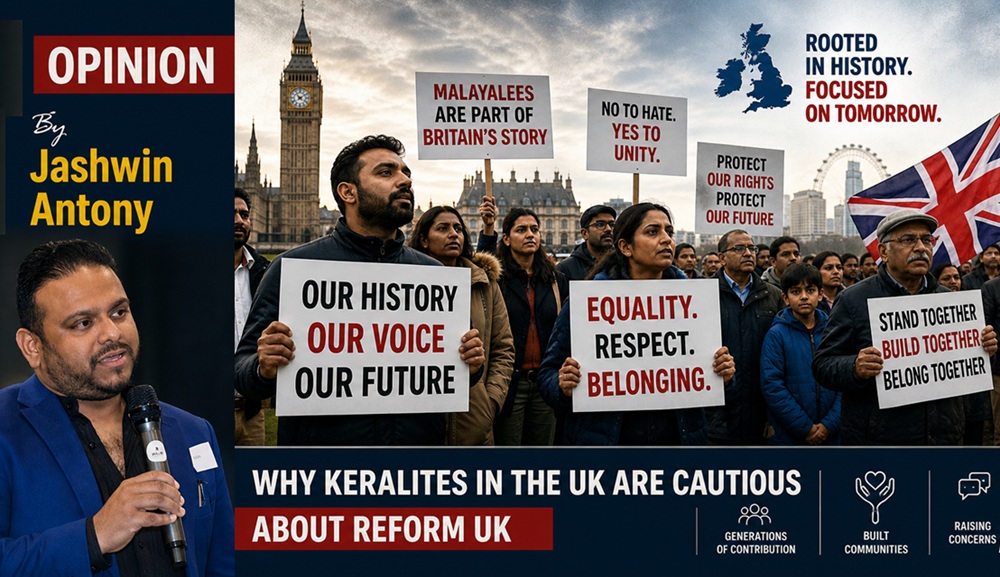
A recent post highlighting candidates from Reform UK sparked strong reactions among sections of the Keralite community in the UK. What followed was a wave of criticism, discussion, and calls for political caution — most notably from writer and entrepreneur Jashwin Antony, who has urged fellow Malayalees to reconsider supporting Reform candidates in local polls. At the heart of this response lies more than just present-day politics. For many British Malayalees, the reaction is rooted in memory, history, and lived experience passed down through generations. Jashwin shares his opinion with this website’s reporter.
A Legacy That Shapes the Present
Jashwin Antony, who was born and raised in the UK, reflects on stories told by his grandfather — part of the first wave of migrants who arrived in Britain during the 1970s and 1980s. These stories describe a time when racism was overt and unapologetic, when signs reading “No Blacks, No Irish, No Dogs” were common, and when South Asians frequently faced violence under terms like “Paki-bashing,” regardless of their actual background.
These were not isolated incidents but part of a broader national climate. From the unrest in Southall in 1979 to tensions across cities such as Birmingham, Liverpool, Manchester, and Bradford in the early 1980s, questions of race, belonging, and identity were deeply contested. Cases like the Newham 7 further highlighted the difficult realities faced by young ethnic minorities navigating issues of justice and self-defence. For today’s generation, these are not distant historical events. They are stories embedded within families and communities—reminders of a time when acceptance was hard-won and fragile.
Unity Amid Adversity
Despite these challenges, Jashwin recalls a strong sense of solidarity among minority communities. Relationships were built across ethnic and cultural lines, united by shared experiences of exclusion and resilience. Even differences in how racism was experienced — such as among Irish and South Asian communities — were understood within a broader collective struggle. This shared history has helped shape a distinct awareness among many British Malayalees: that social and political rhetoric can have real consequences.
Concerns Over Political Messaging
It is within this context that concerns about Reform UK emerge. According to Jashwin, some of the party’s positions — particularly around immigration, integration, and settlement rights — raise questions for communities that have spent decades contributing to British society. For many Keralites, who form a significant part of the NHS workforce and wider economy, such discussions are not merely policy debates. They touch on deeper issues of belonging, identity, and how future generations will be perceived. The concern is not necessarily about political allegiance, but about the tone and implications of certain narratives. Jashwin suggests that those who have not experienced or inherited the realities of earlier decades may view these issues differently — making it all the more important to engage in open dialogue.
A Question of Voice and Responsibility
Importantly, Jashwin emphasizes that this is not about restricting political choice. Individuals remain free to support any party they wish. However, he argues that this freedom also extends to questioning and challenging those choices — especially when they may impact wider community interests. The Keralite presence in the UK spans decades and geography. From London to smaller towns and cities, Malayalees have established themselves as integral contributors to British life. They are not temporary participants but part of the country’s evolving social fabric.
Echoes of the Past
Ultimately, the protests and concerns being voiced today stem from a collective awareness shaped by history. As Jashwin puts it, history does not always repeat itself in identical ways — but it often echoes. For those who have grown up hearing stories of exclusion, struggle, and perseverance, those echoes are difficult to ignore. Their response is not driven by hostility, but by caution — an effort to ensure that the lessons of the past remain part of today’s political conversations. In this sense, the reaction among Keralites in the UK is less about a single political party and more about safeguarding a sense of belonging that has taken generations to build.
Jashwin Antony is a Basildon-based writer and entrepreneur, founder of Kerala Brewery Company Ltd. His work focuses on the British Malayalee experience and the intersection of identity, culture, and modern Britain. hello@keralabrewerycompany.com or 07950887529