






- March 11, 2026
Home Office revoked 3,100 sponsor licences in 2025 leaving migrant workers destitute
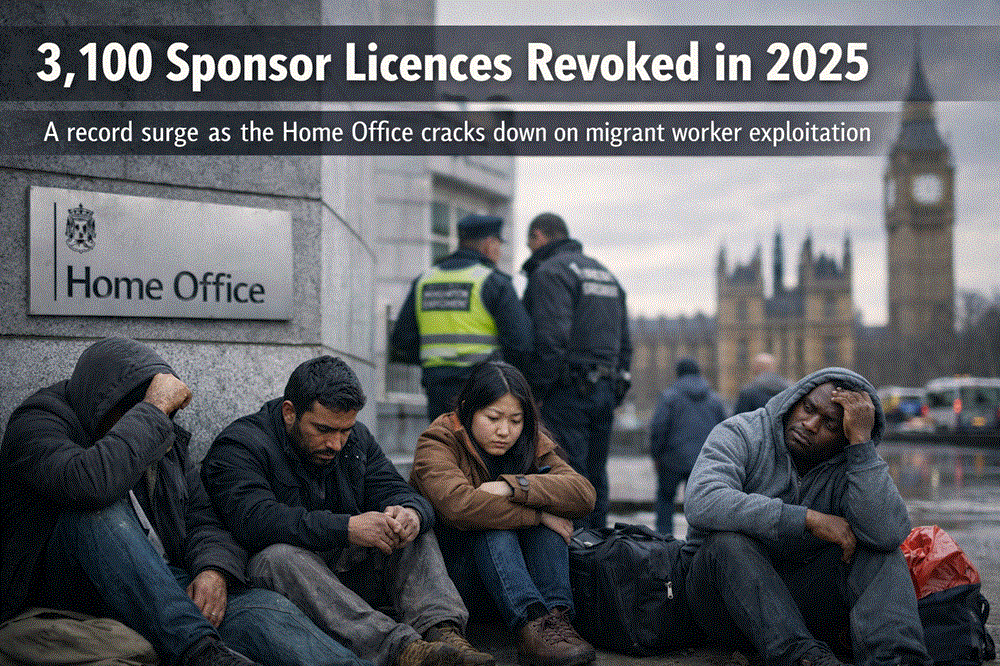
LONDON March 11: The Home Office revoked 3,100 sponsor licences in 2025 – a new record, and the highest number of revocations in any year since records began in 2012.
An analysis by the Work Rights Centre charity found that between October and December 2025, there were 1,516 sponsor licence revocations alone – almost tripling the prior three-month period – as the Home Office adopted an increasingly stringent approach to employers that exploited the migrant workforce.
The exploitation of sponsored workers went far beyond the care sector, a Work Rights Centre freedom of information request found. The results showed that 1,743 businesses were stripped of their licences between Q1 2022 and Q1 2025, but only a third (569) of those revocations were in the “human health and social worker” sector, which includes adult social care.
Two-thirds of licence revocations for this period were in a wide range of other sectors – including construction, retail, and hospitality.
Businesses categorised as “other service activities” saw the second highest number of revocations (259), which includes roles in repairing goods like computers or furniture, personal services such as hairdressing, and roles with membership organisations, including religious organisations.
“Information and Communications” businesses saw the third highest number of revocations (183), including IT consultancies, broadcast and radio production, and publishing.
In her speech at the Institute for Public Policy Research yesterday (5 March) the home secretary Shabana Mahmood emphasised that “enforcement actions are going up”, with no mention of affected migrant workers, while acknowledging that the Health and Care visa scheme (part of the Skilled Worker visa) enabled the proliferation of “phoney care providers” where “fraud was rife”.
The Work Rights Centre argues that abuse of sponsorship is far from unique to the care sector, proving that rogue employers across UK industries are misusing the Skilled Worker visa route to exploit migrant workers and commit fraud.
Chief executive of the Work Rights Centre, Dr Dora-Olivia Vicol, said the organisation welcomed increased action to hold exploitative employers accountable, “but this should not come at the cost of migrant workers being left out in the cold. Every licence revocation means all migrant workers sponsored by that employer will lose their income and risk losing their immigration status.”
She added: “Migrant workers must not be punished for the crimes of their employers. This is not only unjust, but creates a disincentive for all workers to report exploitation, giving unscrupulous employers free rein to exploit as they please.”
Vicol said that migrant workers had been “abandoned as collateral damage in the Home Office’s crackdown on rogue employers, many of which should never have been given a licence to sponsor migrant workers in the first place”.
She said ministers needed to take responsibility for the people who have come to the UK in good faith, “to work hard and pay their taxes, only to be exploited and left jobless, at no fault of their own.”
Exploited workers should not be punished for sponsor wrongdoing: WRC
When a sponsor loses their licence, affected workers are normally sent a visa curtailment letter, which leaves them with just 60 days to secure their immigration status. This process involves: finding a different sponsoring employer, obtaining a Certificate of Sponsorship (CoS) and submitting a new visa application, all within that narrow timeframe. This is often not feasible, which means that workers risk losing their right to be in the UK through no fault of their own.
Although many in government acknowledged this failing, it remains unaddressed. The only policy intervention to date has been funding a network of sponsor rematching hubs for care workers in England, which has a poor track record. In other sectors, there is no formalised support at all.
The most vulnerable workers may be eligible for assistance through the National Referral Mechanism (NRM), a government system for identifying and supporting victims of human trafficking and modern slavery. Yet because the threshold for being identified as a victim is very high, most exploited Skilled Workers fall out of scope of support.
The Home Office also appears to be bad at identifying potential victims, leading to very few workers being referred into the NRM. The Home Office identified only around 80 potential victims on the Skilled Worker visa between 2022 and 2024, according to data obtained by the Work Rights Centre via a separate FOI request. This is a tiny figure, compared with the more than 39,000 sponsored workers employed by non-compliant businesses in the care sector alone.
The government must urgently reform the Skilled Worker regime: WRC
With thousands of licence revocations and no changes to the sponsorship system, the stakes for Skilled Workers are higher than ever.
We welcome this enforcement effort. As the Home Office itself points out, “sponsorship is a privilege, not a right.” But the people who came to the UK in good faith and were subsequently exploited by government-approved businesses are still missing support. In its current design, the system still enables employers to control migrants’ immigration status and livelihoods. And what’s worse, the government now wants to tie workers to their sponsors even longer, by radically restricting their right to settlement.
The sponsorship system needs to change. Workers who have been abused by their sponsors should receive compensation and access support to rebuild their lives. The government should also act on its May 2025 white paper commitment to explore making it easier for migrant workers to switch jobs and escape exploitative employment, and abandon the settlement changes.
Revoking licences is just the start. If it is serious about curbing labour exploitation, the government must address the greater risks inherent in the sponsorship system.