






- March 14, 2026
Home Affairs Committee Urges Caution Over Govt’s Earned Settlement Reforms From April 2026
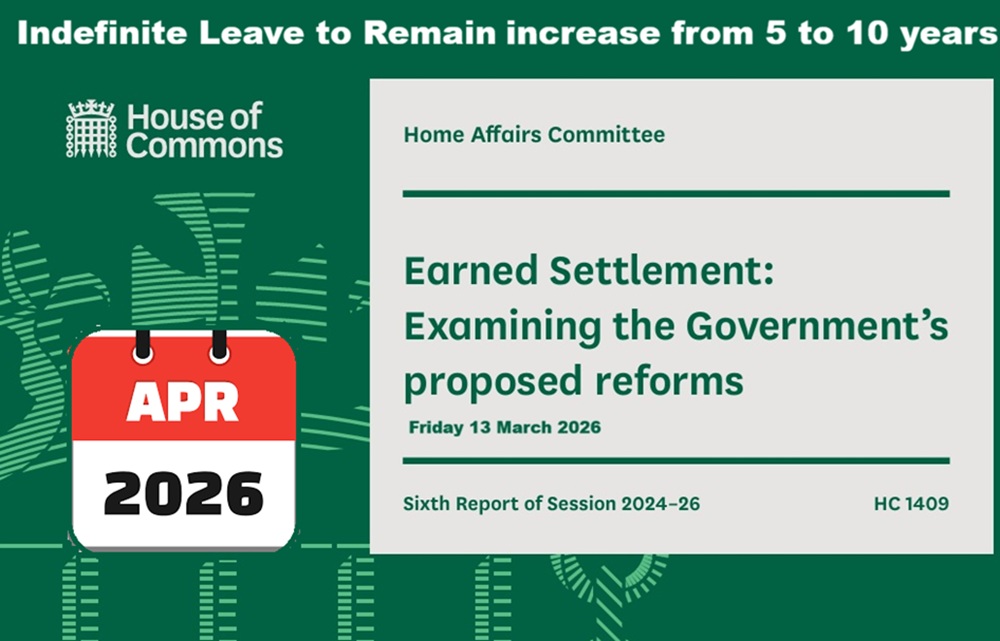
LONDON March 14: The Home Affairs Committee yesterday published an important report examining the Government’s proposed earned settlement reforms, which would extend the standard qualifying period for indefinite leave to remain (ILR) from five years to ten and introduce additional eligibility requirements.
You can read the report online here or down the 87-page PDF file here.
The Committee conducted a short inquiry into the proposals, receiving more than 5,700 written submissions. In its report, it warns that the Government “should learn from previous reforms that it is more important to get changes right than to implement them quickly.” It calls for a clear and realistic implementation timetable, noting that although the Home Office has indicated that changes will begin from April 2026, it has not provided details about when specific elements will take effect.
According to the Committee, key aspects of the proposals remain unclear and insufficiently developed, raising the risk of unintended consequences. It also highlights the significant operational changes required within the Home Office, including adjustments to systems, processes, and staffing, and states that the department is unlikely to be ready to implement reforms of this scale by April 2026. The report suggests that indicating such an early start date has already caused unnecessary distress for migrants who are close to qualifying for settlement under current rules.
While acknowledging the Government’s objective of managing high migration levels, the Committee says the overall effects of the reforms remain highly uncertain. It warns that extending settlement routes could undermine integration if the system is not carefully designed.
The report also raises concerns about plans to apply the reforms retrospectively to migrants already in the UK. The Committee recommends clear transitional arrangements, including protections for vulnerable individuals who may struggle to meet new requirements. It further recommends that the changes should not apply to migrants who arrived before 2021 and are already on track to qualify for settlement through the current ten-year route.
MPs emphasised that uncertainty about the reforms is already affecting many migrants. The Committee states that the lack of clarity around how and when the changes will be implemented is causing anxiety among people living in the UK who are unsure about their future.
Particular attention is given to the impact on children and young people. The report warns that some children could spend most of their childhood with temporary immigration status or reach adulthood before their parents become settled. The Committee argues that children who grow up in the UK should automatically receive settled status by the age of 18, rather than having to “earn” their right to remain. Without strong protections, it cautions, settlement policy could become inconsistent and lead to unfair outcomes beyond young people’s control.
The Committee also highlights financial concerns, particularly proposals requiring migrants to meet a minimum income threshold to qualify for settlement. While acknowledging that it is reasonable for most people seeking settlement to contribute economically, MPs stress the need for clear and reasonable exemptions for those unable to work due to legitimate circumstances, such as disability, full-time caring responsibilities, or study.
MPs were also critical of proposals to shorten settlement routes for higher earners. The report notes that the Home Office has not adequately explained the rationale behind the proposed income thresholds, suggesting they appear to be based on income tax bands as a “convenient, but not yet justified” method for determining eligibility for faster settlement.
In addition, the Committee questioned plans that would place some workers on very long settlement routes based on occupational classifications rather than income. It describes the use of skill levels as a proxy for earnings as “odd and unnecessary”, warning that it could create arbitrary outcomes in which some higher-earning workers wait longer for settlement than others. MPs also warn that extending settlement routes for lower-earning families could increase child poverty, particularly among the children of care workers, and call for a full assessment of the reforms’ impact on child welfare.
The report pays particular attention to the adult social care sector, noting that the Government is already dealing with the consequences of what it calls “fundamental failures” in the expansion of the care worker visa route in 2022. The Committee says ministers now face an extremely difficult choice: either allow large numbers of care workers to qualify for settlement in the coming years, or extend settlement routes in ways that could leave workers exposed to longer periods of poverty and exploitation, or encourage them to leave the sector. It adds that there is no evidence that the Home Office has coordinated these reforms with the Government’s broader strategy for adult social care.
Finally, the Committee warns that longer settlement routes could increase the risk of migrant worker exploitation. Requiring migrants to remain on employer-sponsored visas for up to 15 years may reinforce power imbalances between workers and employers unless more flexible visa arrangements are introduced.