






- March 7, 2026
Can a person with non-British passport with Right of Abode travel to the UK?
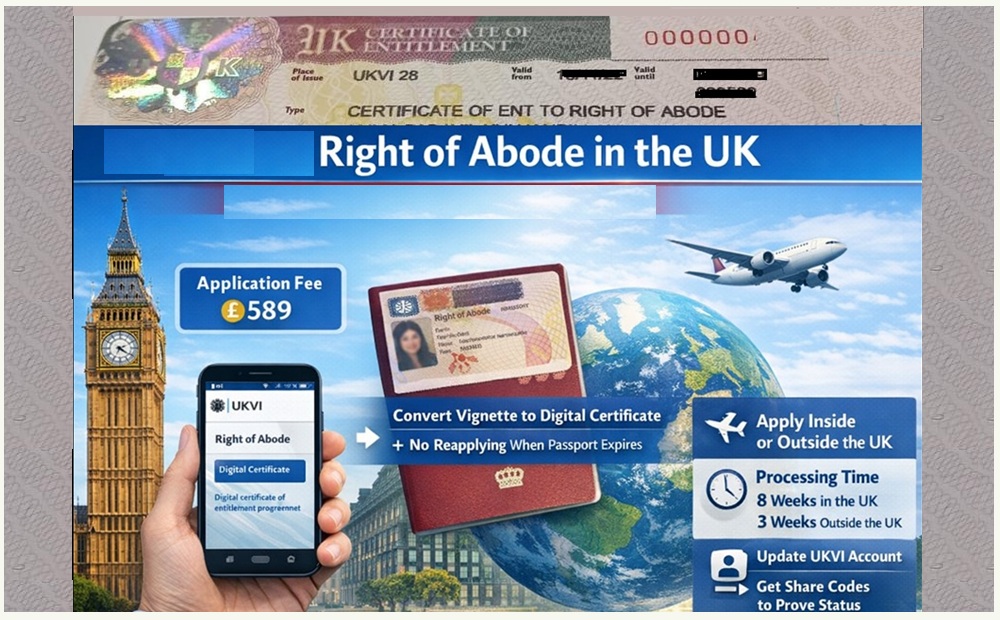
LONDON March 7: The Home Office advises British citizens who have dual nationality to use a British passport, or apply for a certificate of entitlement to the right of abode, to travel to the UK.
As of 26 February 2026, Certificates of Entitlement to the Right of Abode are issued in a digital format and last indefinitely, even after the associated passport expires. However, holders must update their UK Visas and Immigration (UKVI) account to link the certificate to any new passport.
Certificates of Entitlement to the Right of Abode Digital Certificates do not expire; they remain valid as long as they are linked to a valid, non-British passport in your UKVI account.
Paper/Vignette Certificates: Older paper stickers in a passport remain valid until that specific passport expires.
The validity of Certificates of Entitlement to the Right of Abode proves your right to live and work in the UK indefinitely, but must be linked to a current passport for travel.
If you obtain a new passport, you must use the “Update My Details” process to link it to your digital certificate.
All British citizens have the right of abode in the UK (meaning, the entitlement to live or work in the UK without any immigration restrictions). This makes them exempt from immigration control. They don’t need an immigration officer’s permission to enter the UK but, to be granted entry based on their British citizenship, they must be able to demonstrate that they have the right of abode.
They are expected to do this by showing a current British passport or a certificate of entitlement to the right of abode (an official document): paragraph 12 of the immigration rules and section 3(9) of the Immigration Act 1971.
Better use a British passport
The most obvious choice for most people is to apply for a British passport.
It costs more to apply for a certificate of entitlement (£589) than a British passport (£94.50 for adults or £61.50 for under 16s when applying online), and may take longer. People can’t have a certificate of entitlement at the same time as a British passport.
Until 26 February 2026, certificates of entitlement were issued as a sticker attached to the holder’s foreign passport and were only valid for as long as the foreign passport they were attached to. They are now issued in a digital format. A digital certificate lasts indefinitely, even when the foreign passport expires, but the holder will need to update their UK Visas and Immigration account to link their certificate to their new passport’s details. The Home Office’s guide for applying for a certificate of entitlement to the right of abode provides more information.
Coming to the UK without a UK passport or certificate of entitlement
British dual nationals whose other nationality is for a ‘non-visa national country’ (meaning, one which isn’t subject to a UK visit visa requirement) used to be able to travel to the UK using their foreign passport without a certificate of entitlement. They potentially faced delays at UK passport control if they declared their British citizenship, while Border Force staff confirmed their right of abode, although that was less likely to happen if they used an automated passport gate to enter the country.
As explained below, the introduction of an electronic travel authorisation (ETA) requirement for non-visa national visitors means that people with dual citizenship for the UK and one of those countries can no longer simply use their foreign passport to travel to the UK. Many British dual nationals are affected by this. For example, Australia, New Zealand, Canada and all EU Member States are non-visa national countries.
British-Irish dual nationals are not affected. An Irish passport can still be used for unrestricted travel to the UK without an ETA. Click to Read Full Publication