






- February 8, 2026
UK Pravasi Helpdesk Director Anoop Raises Migrants’ Concerns Through Local MP Intervention
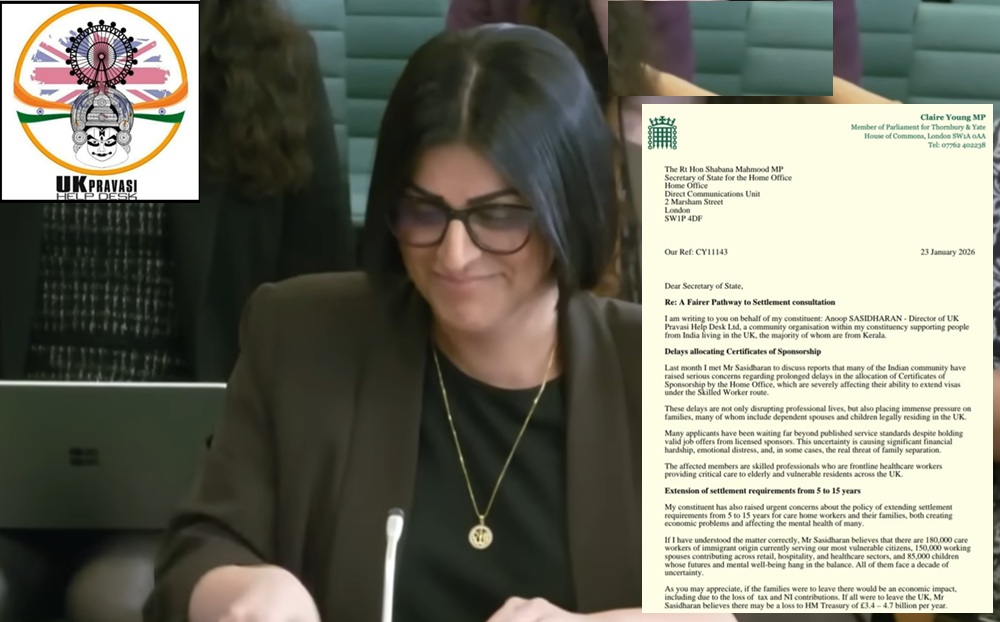
LONDON Feb 8: Thousands of overseas migrants living and working in the UK on Skilled Worker visas are facing growing uncertainty as the government considers extending the qualifying period for Indefinite Leave to Remain (ILR) from the current five years to ten years or more. The government’s consultation, titled “A Fairer Pathway to Settlement,” is set to conclude on 12 February 2026, prompting urgent representations from migrant support groups.
At the forefront of this effort is Anoop Sasidharan, Director of UK Pravasi Helpdesk Ltd, a community organisation supporting Indian migrants in the UK, the majority of whom are from Kerala. Concerned about the far-reaching impact of the proposed changes, Anoop approached his local MP, Claire Young, Member of Parliament for Thornbury & Yate, seeking her intervention.
Following discussions with Anoop, MP Claire Young formally raised these concerns with Shabana Mahmood MP, the Secretary of State for the Home Office, through a detailed letter outlining why the government should reconsider plans to extend the ILR qualifying period.
In her letter, Claire Young highlighted the serious challenges faced by Skilled Worker visa holders, particularly prolonged delays in the allocation of Certificates of Sponsorship (CoS) by the Home Office. These delays, she noted, are preventing many migrants from extending their visas despite holding valid job offers from licensed sponsors. The uncertainty has resulted in financial hardship, emotional distress, and, in some cases, the looming threat of family separation.
The letter emphasised that many of those affected are frontline healthcare and care-sector workers, providing essential services to elderly and vulnerable people across the UK. Anoop also raised alarm over proposals to extend settlement requirements for care home workers and their families from five years to as long as fifteen years, warning of severe economic and mental health consequences.
According to Anoop’s estimates, around 180,000 immigrant care workers are currently serving vulnerable communities, supported by 150,000 working spouses contributing to sectors such as retail, hospitality, and healthcare, and 85,000 children whose education and well-being are at stake. Prolonged uncertainty, he argues, could push families to leave the UK altogether, potentially costing the Treasury an estimated £3.4 to £4.7 billion annually in lost tax and National Insurance contributions.
Beyond the economic impact, Anoop warned of systemic risks to the UK’s care sector. Difficulties in recruiting and retaining international care workers could lead to care home closures, increased pressure on the NHS, and heightened risks for elderly populations dependent on social care services. The uncertainty is also affecting supply chains and associated industries, creating instability for workers trying to build long-term futures in the UK.
Claire Young’s letter further highlighted the human cost of the proposed changes, including rising anxiety, relationship breakdowns, declining school performance among children, and families contemplating leaving the country mid-academic year. “These families are not statistics,” the letter stressed, “they are the backbone of our care system, contributors to our economy, and members of our local communities.”
To illustrate this impact, Anoop shared the case of a care worker from Kerala who has served elderly patients in the UK for eight years. Her husband works at a local Tesco, and their 14-year-old daughter—born in the UK—now fears losing her friends and school. Despite contributing £42,000 annually to the economy and paying £8,500 in taxes, the family is experiencing severe stress, with the mother requiring multiple GP visits for anxiety and the child’s academic performance declining.
Through UK Pravasi Helpdesk, Anoop continues to advocate for an immediate review of the proposed settlement extensions, retention of a five-year pathway to settlement, and reductions in visa fees to ease financial pressure on migrant families.
As the consultation deadline approaches, migrant communities across the UK are watching closely, hoping that sustained advocacy—now echoed in Parliament—will lead to a fairer and more compassionate immigration policy.