






- July 28, 2025
Onset of a Third World War? Dr Cyriac Maprayil
Dr Cyriac Maprayil
We witnessed the survival of the world through the Cold War years, thanks to the stamina, vision and consistency of purpose displayed by the founders of the Non-Aligned Movement (NAM). In the words of the late VK Krishna Menon, “The Non-Aligned Movement originated under the leadership of Nehru of India, Tito of Yugoslavia, Sukarno of Indonesia, Nkrumah of Ghana and Nasser of Egypt.
Their remarkable achievement has been the creation of a coalition of states from Asia, Africa, Europe, the Middle East and Latin America and the Caribbean which has grown from its original 25 to over 100 members. One of the first principles of non-alignment is peace and disarmament.
Historically the movement has sought to reduce tensions between the major powers. From its inception, the movement has been opposed to the development of military blocs and the attempts by the major powers to compartmentalise the world into spheres of influence.” (AW Singham and S Hune, Non-aligned in an Age of Alignments). Unfortunately the non-aligned movement is no longer able to negotiate proactively as impartial outsiders in the face of crisis.
However when Iraq was invaded by two permanent members of the security council without providing adequate proof of the existence of weapons of mass destruction to justify the invasion, as Kofi Annan wrote, “For much of the global community in those days – shocking though this seemed to many Americans – the greatest threat to world peace came not from Sadaam but from an enraged and vengeful United States” (K Annan, Interventions: A life in War and Peace).
Subsequent destabilisation of the neighbouring countries including Gaddafi’s Libya and Assad’s Syria keep reminding the world that there are many areas of conflict where the permanent members of the Security Council are directly involved and need to be seriously looked at and sorted out by the General Council of the UN to ensure that global flare-ups resulting in world wars do not happen.
After Gorbachev’s Presidency the Warsaw Pact comprising of countries of Eastern Europe financed and controlled by Moscow was dismantled, but before long the US-led NATO stepped in to fill the apparent vacuum.
Although the Russian move was seen as a step in the right direction, NATO countries unfortunately failed to use the opportunity to begin to work with the Russians to create a global environment that would be conducive to peace and disarmament. However NATO exploited the opportunity to bring the East European republics into its fold.
Russia – Ukraine War
The latest Russia-Ukraine war and the apparent inability of both sides to agree to a ceasefire to begin a serious dialogue on outstanding issues once again highlights the need for the General Council to find a way out of the impasse by appointing a mediator independent of the UN security council who has adequate understanding and appreciation of the origins of this ongoing conflict.
Russia previously expressed fury at the apparent NATO-backed overthrow of the Moscow-friendly leader of the Ukraine subsequent to which it annexed Crimea and supported the separatists in their attempt to control its Donetsk and Donbas regions.
Presently, Russia appears to be insisting on assurance that NATO will not seek to expand to Ukraine and that Ukraine will not be seeking the membership of NATO. The Russian Federation is showing symptoms of paranoia and insecurity as if it is being pushed to the wall and being deprived of its sphere of influence, which it mistakenly believes is its entitlement and has apparently adopted a strategy of shoot first and talk later.
The fact that the UN General Assembly is not adequately represented in the UN Security Council and that the latter is not accountable to the former may go some way to explaining why the UN in its current format finds itself helpless while death and destruction is taking place.
Israel – Palestine War
Hamas’s sudden and unannounced brutal attack on Israel and Israel’s equally brutal and well-coordinated retaliatory actions, including the ongoing siege of Gaza, call for a radical new approach to resolving the perpetual hostility and tension between the two nations of Palestine and Israel that has persisted since they came into existence in 1948.
Initially, the British Government’s commitment and support for establishing a “national home” for the Jewish people in Palestine was announced through the so-called Balfour Declaration of 1917. It was explicitly approved by the League of Nations through its mandate to Britain to administer the area and, in the process, put into effect the Balfour Declaration, “National Home for the Jewish People”, alongside a home for the Palestinian Arabs who formed the vast majority of the local population.
There are compelling humanitarian and legal reasons for Hamas to release all the hostages they took and for Israel to completely lift the Siege of Gaza. The fact that most of the permanent members of the UN Security Council have instantly and unconditionally declared their support for Israel and Israel’s retaliatory actions, to a large extent, undermines the potential role of the UN in resolving the crisis.
Naturally, the Arab nations are instinctively drawn closer to the people of Gaza, who are under siege and deprived of everything. By now, European nations, including Italy, Germany and France, must possibly be regretting the speed with which they jumped on the US bandwagon without putting any conditions on their support.
The European Union could step in to support the UN’s mediation efforts. It might be more effective than the US or Israel’s Gaza-friendly Arab neighbours.
The decision to create the two nations was taken by the UN in the aftermath of the Second World War. It was imposed on the Palestinian Arabs, ignoring their protest. Any new initiative must be preceded by a serious and significant de-escalation process, which the United Nations Secretary-General should ideally guide.
The ongoing active armed conflict between Israel and the Palestinian people has already spread to neighbouring countries including Lebanon and Syria. The Israeli government is not ready for a ceasefire that could lead to a possible settlement, obviously, counting on the unconditional support extended by the US.
Away from the Middle East and unconnected with the above conflict, Europe has been witnessing and to a significant extent participating in another ongoing active armed conflict between Ukraine and Russia, the former being comprehensively supported by NATO as well as the major countries of the European Union.
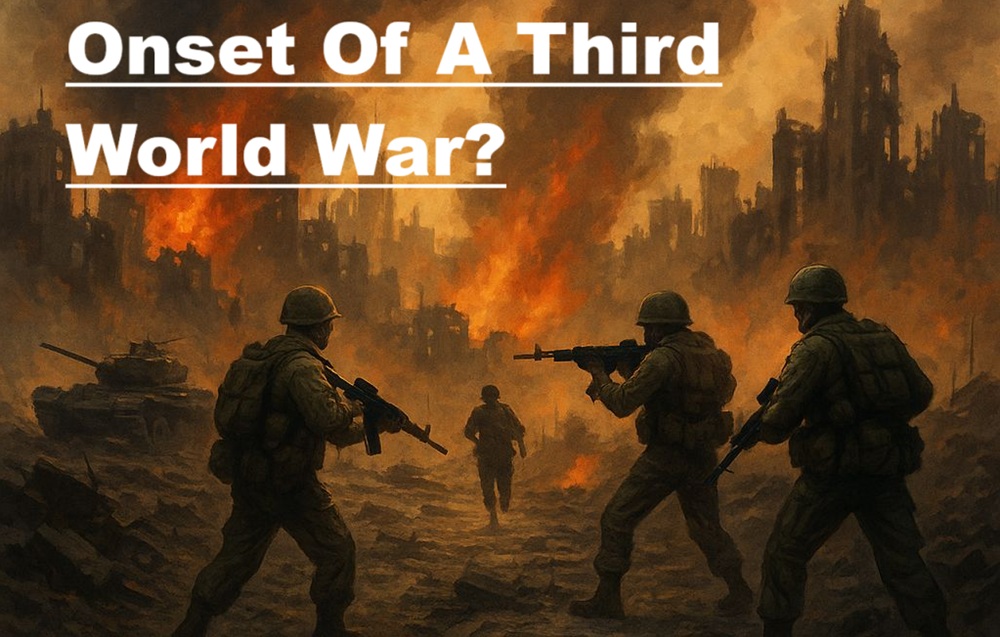
These two conflicts are disastrously polarising the world into two rival groups and it is difficult not to see the obvious symptoms of an impending global war.
It was in the immediate aftermath of the Second World War that the Allied forces including the Soviet Union which fought and defeated Germany came together (Yalta and Potsdam Conferences) and gradually established a framework – The United Nations – within which disputes between nations can be discussed and resolved peacefully, avoiding wars.
Although too many conflicts, both large and small, have taken place since the conclusion of the Second World War, the UN organs of preserving peace have managed to handle them.
If the two major current conflicts detailed above are not resolved without further delay the world will be dragged into another World War. Since some key members of the Security Council, which has a responsibility to protect the world maintaining and promoting peace and harmony, are finding it impossible to do what is expected of them, the only way forward is left to the General Assembly of the UN to initiate action under the Uniting for Peace provision.
The UN Summit of the Future held in 2024 was considered a once-in-a-generation opportunity to enhance cooperation on critical challenges and address gaps in global governance. It is hoped that the present structures of the organs of the UN will be adequately reviewed and made effective and functioning making it impossible for the members of the Security Council to join one side or the other in a conflict.
Dr Cyriac Maprayil is a writer and historian whose work focuses on international political relations and South Asian affairs. He is the author of a number of books, including Nehru and The Commonwealth. He is a fellow of the Royal Historical Society and a regular contributor to the online newspaper Indians Abroad.
The views expressed in the above column is solely that of the author and does not necessarily reflect the views of this website or its editor.