






- January 18, 2026
Has Bollywood Abandoned Stereotypical NRI Themed Movies of 90s?
By Dr Parvathy Poornima (Assistant Professor, School of Humanities, St.Joseph’s University, Bangalore)
This article delves into how Bollywood left behind the 1990s NRI fantasy and the current absence of diaspora blockbusters. Social media, global exposure, and shifting political landscapes have dismantled the myths about culturally nostalgic NRIs both on- and off-screen. The article examines how this shift is creating a new identity crisis for NRIs and explores whether Bollywood can ever relive the NRI dream it once celebrated.
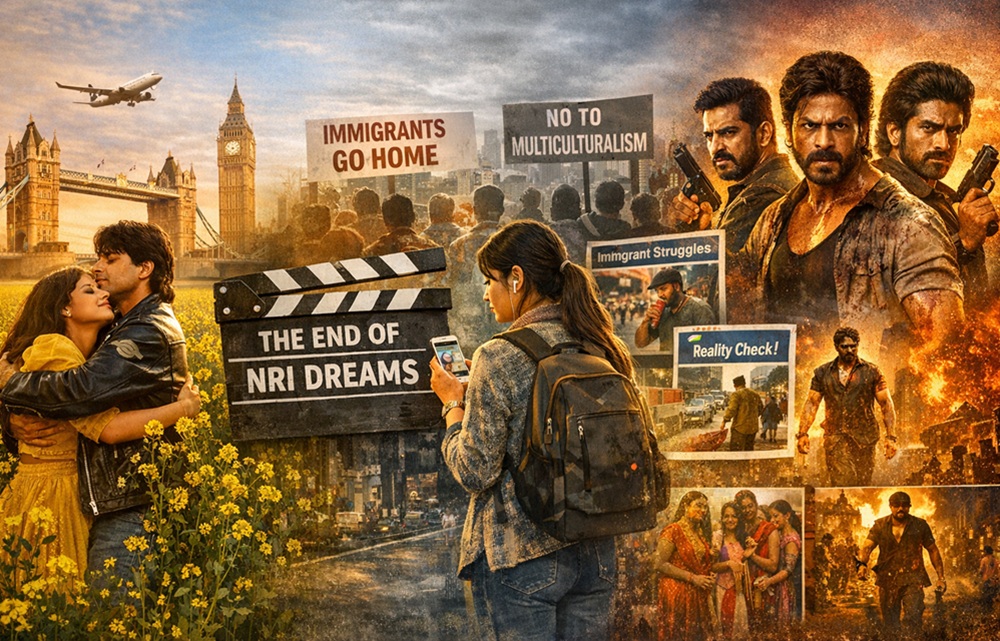
The celebrated shot of Simran in Raj’s arms, in the frame of a mustard field adorned with golden yellow flowers, somewhere in the north Indian plains, and their dreamy end credits scenes in London from the Bollywood blockbuster Dilwale Dulhania Le Jayenge not only sold a romantic fantasy but also effortlessly spread a glamorous ‘culturally nostalgic Indian at heart but Western in guise’ NRI stereotype of 1990s.
The cultural projection of foreign countries as exotic and aspirational reimaged audience’s perceptions of a foreign land as the decade marked migration of second generation Indians to Europe. The vicarious virtual travel assured, fuelled Indian dreams about migration and made those movies a grand commercial success at Desh and Videsh. The political undercurrents of liberalization and privatization were instrumental in promoting the global Indian narrative in an Indian context.
When Bollywood Portrayed a Picture-perfect NRI fantasy
Yash Raj Films, Karan Johar, Farhan Aktar and Nikhil Advani repeated this fairytale frame that catered to the interests of both Indian and NRI audiences throughout the 2000s. Most of the male protagonists of such movies belonged to an affluent class, westernized but were never so western as to morally threaten Indian ways. They enjoyed their lives in Europe, had fun flirting and partied till sunrise yet were culturally rooted. This male NRI trope often got paired with heroines who were mostly independent, educated and opinionated but preferred cultural values, though they succumbed to patriarchal pressures of honour and shame during the course of their romantic endeavors. While living global lives set in Western Europe, these homesick characters celebrated Indian festivals and exerted cultural superiority in their romantic idealism, marital preferences and communitarian family values. Such movies conveniently ignored racism, casteism, gender discrimination, honour-based violence, stringent immigration regulations and other problems related to NRI lives. Studies indicate that South Asian diaspora grapples with these challenges in their everyday lives. Nevertheless, today’s Bollywood hardly depicts such fairytales. The disappearance of NRI stereotypes from Indian cinema uncovers the changes Bollywood brought to its relationship with the diaspora. While pondering why Bollywood abandoned its diaspora tales, it highlights the economic, cultural and political dimensions of the issue.
Multiplexes boom, Overseers Collections Dip and Tastes change
During the 90s and 2000s, NRIs were golden ticket for the distribution of Indian movies and overseas box-office collections contributed a whopping 20-30% of the total revenue generated by these releases (The Economic Times, 2017). Fast forward to today, the collections are about 7-10% only mostly due to domestic growth of multiplexes and OTT platforms. Evidently, overseas revenue is no more a profit driver for NRI movies. Bollywood’s reduced dependence on diaspora audience compounded this change in taste in the movie genre. NRI themed movies migrated from theatres to OTTs by and large as binge worthy TV series depicting diaspora lives. On the other hand Bollywood’s global presence is reinforced through pan-Indian movies released abroad. Movies like Dangal, Jawan & Pushpa 2: The Rule with no NRI content smashed box office records overseas too.
Death of idealistic Myths, Social Media Invasion and Normalization of NRI Experience
The culturally nostalgic NRI heroes sold idealistic myths about the joint family system, ritual abundance of lavish Indian weddings; unwavering moral codes, primarily to first generation immigrants who faced cultural dislocation. But the fantasy no longer resonates both in India and abroad. In a globalized world, identity formation travels beyond reliance on media consumption alone as it once was. The contemporary diaspora voice is not homogenous but diverse. Unlike he culturally nostalgic NRIs of 1990s, they engage with discrimination, minority rights and intersections of race, class, caste and gender politics of identities in host countries, and it poses commercial risks for moviemakers as cultural products are inspected for political nuances. Personal freedom and agency dominates diaspora debates today rather than the collective identity of Bollywood’s imagined Indian diaspora. Emphasis on female agency and self-discovery of women outside tradition-confined domestic roles challenges the happily ever-afterness of glossy big fat diaspora weddings onscreen.
Social media gave direct access to popular culture which was the exclusive prerogative of Bollywood previously. Global exposure and digital spaces normalized the NRI exposure, which was a rare celluloid experience otherwise. Instagram Reels reveal gutka (paan) stains on the sidewalks of London, public Indian ritual practices being challenged in the US, and many other mundane realities of NRI lives. As cultural backlash against South Asian immigrants in general grow, social media spotlights it. A rather normalization of NRI experience unravelled the challenges and struggles of immigrant and diaspora life abroad, which let go of the fantasy.
Is there an identity Crisis that NRIs weren’t Prepared for?
The culturally nostalgic NRI image became ideologically incongruent in a territorial nationalistic context of post-liberalization India. Transnational flows of culture, media and lifestyle intensified by globalization ‘disembodied culture from place and tradition’ (Appadurai 1996). This was felt in India as the dominance of western culture over indigenous, catalysing the growth of cultural nationalism. This change aligned closely with the BJP’s ideological framework. Eventually, Bollywood also started shifting inward; focusing on domestic concerns. The number of NRI themed blockbusters declined in the post 2000s when diaspora fantasy was replaced by local realism.
The emergence of populist right wing nationalism in Europe opposed multiculturalism and integration of foreign cultures. There existed a cultural backlash against globalization as scholars call it. This change had an indirect impact on the market for diaspora themed movies and nationalist themed NRI movies underperformed abroad. Directors and distributors intended to avoid politically controversial or loaded movies for box office releases (Livemint 2025).
This transition debunked the myth of the diaspora being a uniform nationalistic market conducive to Bollywood blockbusters abroad. When they struggle to belong while perceived as suspicious minority abroad, NRIs are losing the symbolic global belonging that Bollywood once offered as well. Hence, NRIs cannot decide if homeland advocacy or activism for an inclusive NRI life abroad is going to reinforce the good old symbolic ties.
To conclude, the moment diaspora stopped behaving like a homogenous audience, the desire created by the distance ceased to exist. Social media and shifting political ideologies in home and abroad deepened this further. When identity is constantly negotiated across borders rather than preserved through nostalgia, Raj and Simran can return to onscreen only if they engage with the challenging multicultural identities and structural problems that modern diaspora contemplates!