






- December 4, 2025
A week in the ‘Red City’ Marrakech in Morocco
By Dr Chitra Gopinathan
Chitra Gopinathan is a Consultant Anaesthetist working at Queens Hospital in Romford. Her hobbies and passions are varied. She enjoys the creative side of herself. She attempts a bit of writing and drawing when she gets the chance and feels inspired. She has a blog site, ‘Chitra’s musings’ at gchitra.com. Although it was a regular feature, it has now become a bit adhoc as she puts it. She enjoys reading, travelling and eating out.
At the airport the omens were looking good. The Malayalee guy at the airport restaurant bar gave us two cappuccinos when we only asked for one. I try to stick to decaffeinated drinks but was not going to turn down a freebie. The hotel we had booked in Marrakesh had good reviews at the time of booking but as our trip neared the reviews were pretty bad. I wondered what I was letting myself in for. It will be all okay I tell myself, and lower my expectations.
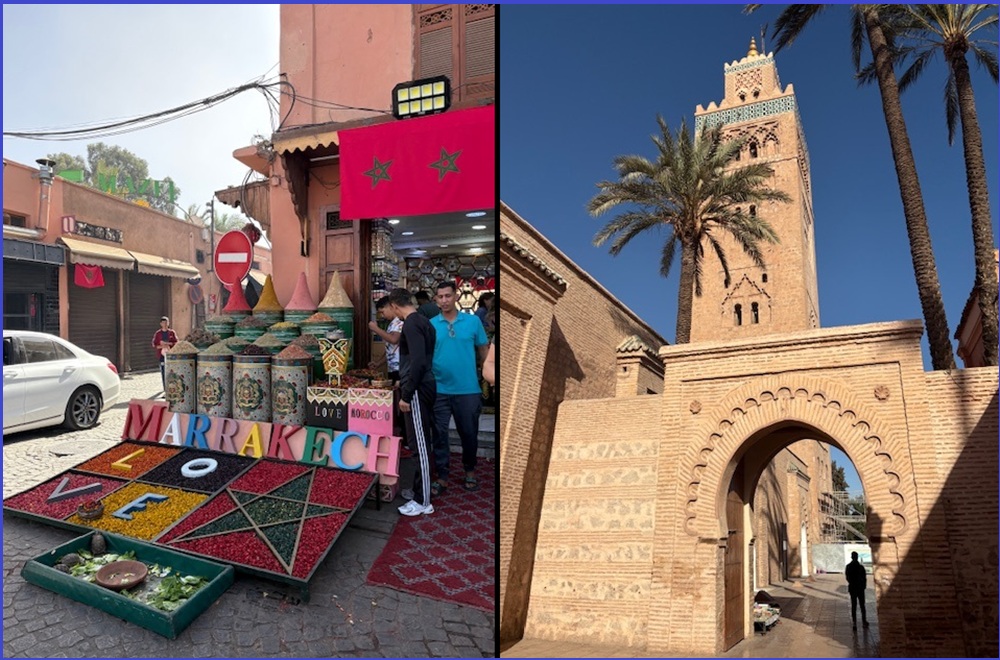
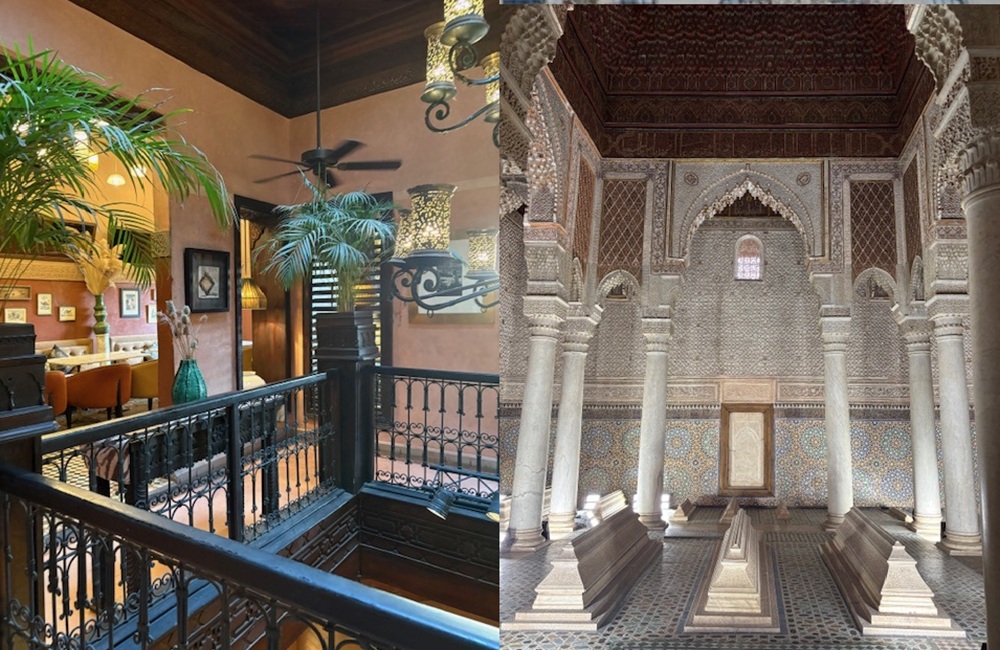
Our hotel is situated about 8 kilometres from the centre where all the action is. There is a free shuttle bus every morning and afternoon from the hotel to Jemaa el-Fnna, the main square. These days the first thing I do when I’m in a foreign city is a walking tour with a guide to get myself acquainted with the place. These local guides are a minefield of information and happy to answer and clear any doubts. They know where the best restaurants, shops and places to visit are. The talks always start with a brief overview of the history of the region and how centuries of inhabitation, invasions and religions shaped the country. The shuttle bus stop is across from the Koutoubia mosque. I have five minutes to find the meeting point for the walking tour and promptly get lost. I finally find the group. We are about ten minutes late but we’ve only missed the introductions. It is a scorching day, sweltering to my standards but the guide tells us that this is their cooler month and most local people are wearing layers to ward off the cold. Thirty degrees in the sun is too much for me and I open my umbrella in areas where there is no shade. I am the only one with an umbrella but I need it. The guide points out the important monuments during the walkabout. After the walking tour which lasts almost 3 hours, we have lunch in one of the rooftop restaurants overlooking the square. The dates soup looked promising and we opted to try it with a mint tea. The dish came with the local ‘halwa’ which resembles a brown jilebi drizzled with honey. After lunch we retrace our steps and visit the Bahia palace and Saadian tombs. The Palace architecture is Moorish and resembles that of the Alhambra palace in Granada which we visited just a couple of months ago.
The next day we are in Jemaa el-Fnaa again but this time we’ve booked a food tour in the afternoon. As we had plenty of time to kill before the tour starts we walk to ‘Gueliz,’ Marrakesh’s modern district. We are too early even at 1030 in the morning and the shops are just waking up. I spot a McDonalds and decide to take a comfort break before finding our way back to the medina and souks. ‘Anna, anna’, someone is calling out. Surely it’s not aimed at us and we walk on. Then it starts again, and yes it is aimed at us. It was someone we know from Croydon. We stop at an arts market on the way back where local artisans are selling their wooden, leather and other creations. At our designated time we meet Kamal for our food tour. He normally does these tours in the evening when the medina comes alive but we opted for an afternoon one. Our first stop was a dish Moroccans normally have for breakfast, a type of pancake which resembles a stuffed paratha and soup served with halwa. Next stop was where the stall owners go for lunch. A type of omelette with tomatoes and meat served in its pan with bread. Kamal shows us how it is eaten and tells us that this is what the university students cook as it is an easy and nutritious dish to make. Next he explains how a tanjia is made, meat is seasoned with safran and cumin and slow cooked in covered tanjia earthenware pots in burning ashes over a few hours. People take these pots to their local hammams or public ovens to cook and collect it several hours later when it’s done. The restaurant in the souk he takes us to is a popular place from where celebrities come to try the tanjja and has its own oven. Even the Queen was served the dish from here when she visited Marrakesh. The shop resembles that of a tea shop you see in Indian villages and I couldn’t see the Queen sitting at one of these crowded tables. It was one of the best melt in your mouth lamb dishes I have ever tasted. Along the way we stop off at an olive and harissa stall to taste the different varieties of olives, plain and seasoned. The harissa paste is too hot compared to the harissa served at our hotel which I have been adding to every single dish since my arrival regardless of whether it is the morning porridge, afternoon soup or evening dishes. As we pass a prickly pear (cactus fruit) stall I ask Kamal what it is and he buys some for us to try. We round off the trip drinking dates ground in milk and avocado in orange juice. We have no space left for the pastries and opt to take it home. Kamal drops us off at the entrance to the Secret gardens where we spend some time relaxing before making our way to the shuttle bus pickup point.
The next morning we wake up to howling winds and pouring rain. The temperature has dropped ten degrees from the previous day. It only rains a few days in Marrakesh and the locals consider it a blessing. We take a day off from touring and enjoy the resort facilities.
Jardin Majorelle was initially owned by the French painter Jacques Majjorelle who filled the garden with exotic plants from around the world and in 1980 Yves Saint Laurent and Pierre Bergé bought it along with its villa. The garden is open to the public and the YSL museum next door houses some of his collections. The garden is filled with tourists posing for pictures at every nook and turn trying to capture the beauty of the place which inspired the designer. After enjoying the garden and museum we walk back to the Medina which is about a 30 minute walk away. As we walk past the stalls some of the stall owners call out and ask if we are Indians and then their next question will be ‘Sharukh Khan?’
As the afternoons merge into evenings the Jemaa el-Fnaa square gains a festival type vibe that we experience back home during the temple festival periods. The snake charmers and dressed up monkeys in chains occupy the centre of the square during the day time and they give way to street entertainers and henna artists in the evening. The rest of the square is taken up by fruit and food stalls. The rooftops of the surrounding restaurants become a vantage point to sit back and watch the crowds. The walk back to our shuttle meeting point takes us past lines of dressed up horse carriages waiting for tourists.
Marrakesh is situated at the foothills of a mountain range which separates it from the Sahara Desert. A trip to Marrakesh will not be complete without a trip to the Atlas Mountains. Abdullah arrives on time to pick us up. The first stop is a breakfast one at the women’s co-operative. We’ve already had breakfast but I still devour the soft barley bread served with amlou, argan oil and honey washed down with a herbal tea sweetened with honey. Argan tree is indigenous to Morocco and the oil is used as a cosmetic and for cooking purposes. Goats feed on the fruit and the seed which is discarded is collected, the hard shell removed and the seeds ground to extract the oil. The cooking oil is derived from the roasted seeds. The residue is collected and used to make soap. Nothing is wasted. The women at the co-operative give us a demonstration as to how the argon oil is extracted. The next stop is Ourika valley where we sit by the river and enjoy a glass of coffee brewed in hot milk. The river water is muddy from the rainfall from the previous days. A number of years ago a flash flood destroyed this area and now they have an early warning system which gives them enough time to evacuate, although the need for it has fortunately not risen. Across the river a donkey comes down the slopes carrying luggage with the donkey’s owner and the bag’s owner following it. It stops at the bridge where the bags are taken down and the tourist continues his journey along the narrow wooden crossing. We continue our drive up along the winding mountain roads. Abdullah says he can do this trip with his eyes closed. ‘Not today, please’, our fellow travellers call out from behind me. We have a couple of young university students accompanying us on this trip. I sit at the front with the driver and have the best views. The highest peak, Mount Toubkal, is covered with snow and the rest depending on the mineral content have varying hues. Greenish grey peaks which are rich in copper, red peaks rich in iron, some of the mountains are covered with pine trees and others bare. It gives me the impression of the spice markets in the souks with their different coloured spices arranged in peaks in containers lining the front of the stores. Two years ago an earthquake hit this part of the mountain wiping away entire villages.
Difficulty in reaching these parts worsened the outcome. Houses have since been rebuilt with better infrastructure to withstand earthquakes. By midday we reach our hiking point where Abdul, our Berber guide, meets us and asks if we want to take the difficult, medium or easy hike. We opt for the medium one. Berbers are the original inhabitants of North Africa with history dating back to prehistoric times. Abdul gives us an overview of how the Berber population live. The houses here are made of rocks, clay and straw giving it the same shade as that of the surroundings. There are about 6-7 people living in each of these houses which have about 2 rooms and a kitchen each. The richer houses are made of bricks. Each house has an area for their goats, cows, chickens and rabbits. Agriculture is the main source of income and each family has a plot of land where they grow gala apple, quince and other fruit trees. The water for irrigation comes from the mountains through drains. A group of young schoolchildren are seen walking ahead of us on their way to school. One child’s shoe lace has come undone and Abdul stops to tie it for her. It’s a small community and everyone knows and looks out for each other. From the main winding road we turn inland down a slope and continue our trek along the narrow roads. An elderly lady is sitting by the roadside. Abdul says she is about 120 years old. The life expectancy of the Berber community is long and is attributed to the active healthy lifestyle and avoidance of alcohol. At one point we stop for a donkey carrying mud for a house construction to pass us. The trek is a gentle one but at certain points it is up an incline and as we are on a mountain top where the air is thinner I find myself getting out of breath. Or at least that is my excuse. I’ve been indulging myself during this trip with all the delicious food that I have not been able to resist and am likely to have put on a bit of weight despite all the walking I’ve been doing. At the end of the trek we reach our destination where the lady of the house is busy preparing our lunch. The tagines are lined up outside the kitchen and kept warm on the gently burning ashes. Lunch is served on the roof top terrace overlooking the mountains. It is a pleasantly warm afternoon. Squash soup and bread is served with a salad. The main is chicken and vegetable tagine served alongside couscous. I didn’t realise that even potatoes can taste this good when cooked in a tagine. We couldn’t finish the couscous or the bread but the chicken and vegetables were devoured with relish. To finish of we had fruits and a herb tea. All the dishes were served in colourful crockery by the host who couldn’t stop smiling and laughing which made the experience even more joyful. After using the facilities we wash our hands aver an aluminium bowl covered with a lid with holes while the host poured water from an aluminium kettle over our hands and waited till the soap was applied and washed off. The waste water was collected in the bowl to be discarded later. From past experiences in other countries with similar trips, I was concerned about the hygiene but everything looked clean and pristine. We start our descent back to the hotel stopping off at the fifth and final valley of the tour for a last photo stop.
Our week in Marrakesh is coming to an end and I realise that my anxiety at the start of the trip was ill founded. The hotel was fine, the staff were friendly and food excellent. It was time to say goodbye to the Red City, the land where strangers become friends during their weekly hamam rituals, where friends meet up to share a tangia, where camels are transported sitting atop van rooftops, where before water was available in plastic bottles guerrabs sold water that they carried around in goatskin bags, where I learn that there is an art form to serving mint tea and where refusing such an offering is considered impolite. I had a wonderful break and have stocked up on argan oil and spices and now it is time to head back home.